Articles6 min read

The Sandbox Dig That Created Paleontologists

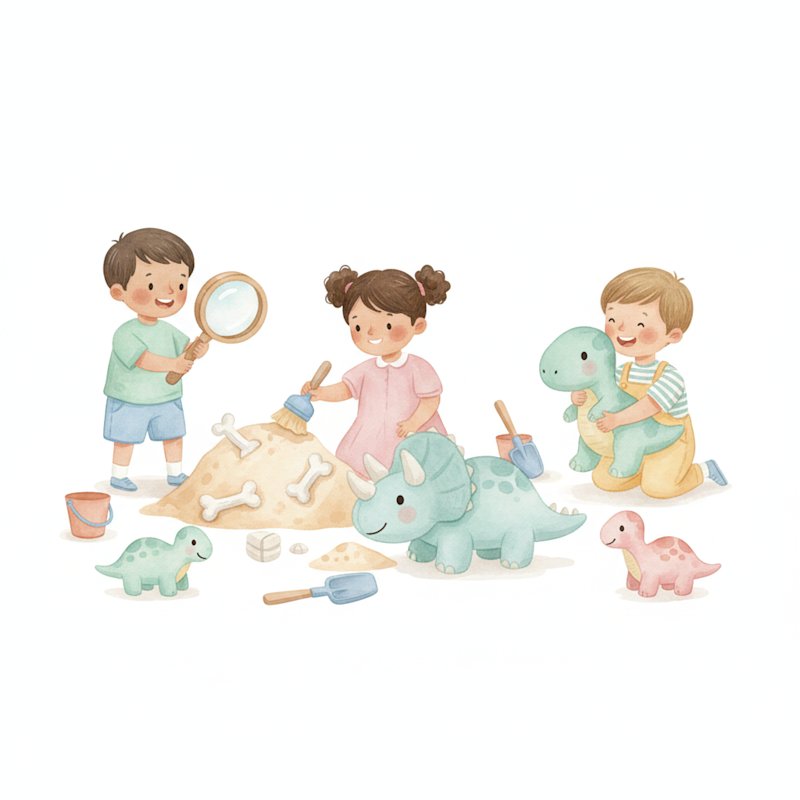
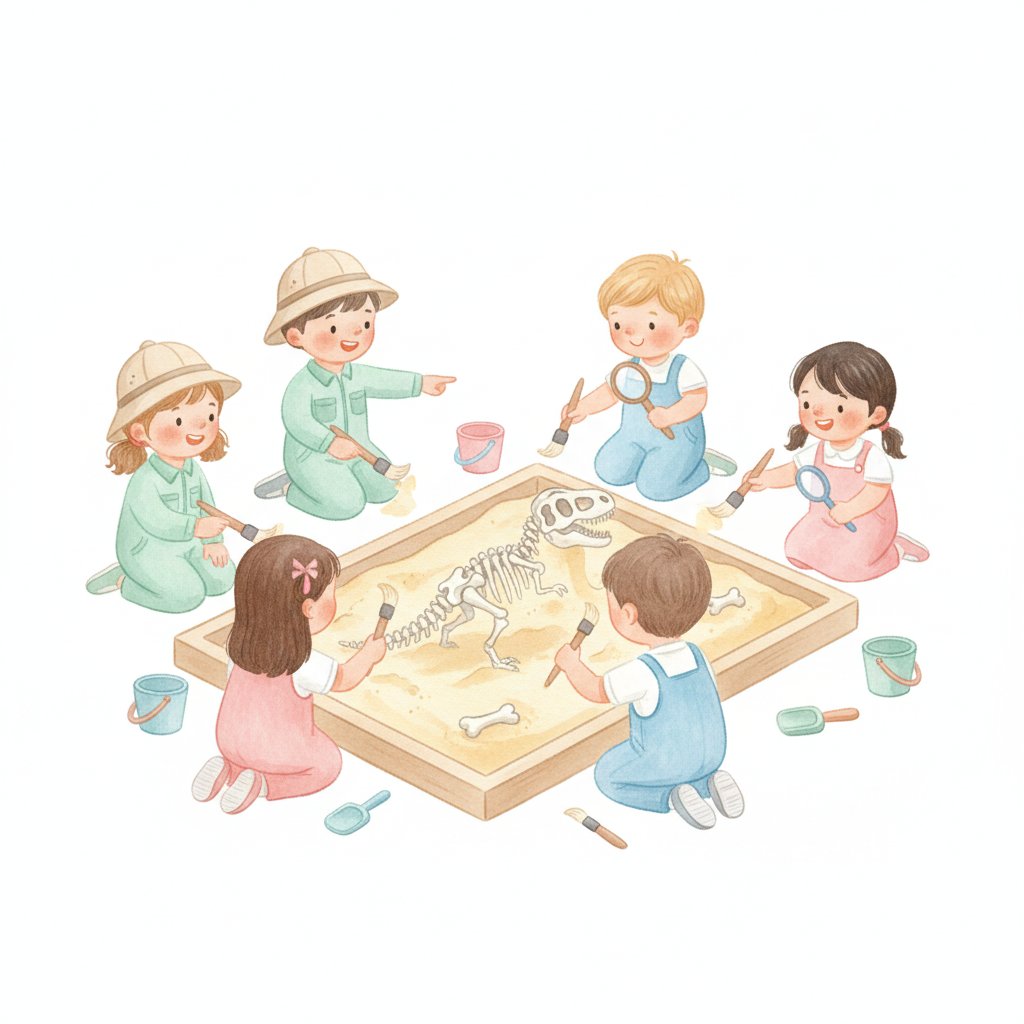
I buried plastic dinosaurs in the sandbox and gave children paintbrushes. "You are PALEONTOLOGISTS — scientists who find dinosaur bones! Dig CAREFULLY. Brush the sand away GENTLY." Four-year-old Marcus froze when his brush revealed a claw. "I found one! I FOUND A CLAW!" His hands were shaking. For the next 30 minutes, every child in the class was laser-focused, carefully brushing sand, documenting finds, comparing discoveries. They didn't know they were practicing science — they thought they were on a dinosaur adventure. But they were observing, hypothesizing, recording, and comparing — the exact skills real paleontologists use. Dinosaurs aren't just a fun theme — they're a GATEWAY to scientific thinking.

According to the National Science Teaching Association, dinosaur education in early childhood builds observation skills, size comparison, time concepts (past vs. present), classification, and scientific vocabulary. Children who study dinosaurs show increased curiosity, questioning, and comfort with large numbers and scale.
This guide covers 20+ dinosaur activities for ages 3-6. Pair it with our science experiments guide for more science and our outdoor play guide for outdoor exploration.
Dinosaur Science and Fossils (Ages 3-6)

1. Sandbox fossil dig
Materials: Sandbox, plastic dinosaurs or bones, paintbrushes.

What to do: "Bury the dinosaurs. Now DIG! Use your brush to uncover them carefully. What did you find? A SKULL! A RIB! A CLAW!" The dig teaches excavation and patience. For more outdoor activities, see our outdoor guide.

Why it works: The dig teaches REAL scientific methodology: careful observation, gentle technique, documentation. "Don't grab it — brush the sand away first. Look at it before you pick it up." These habits transfer to every science activity.

2. Clay fossils
Materials: Clay or playdough, plastic dinosaurs, leaves, shells.

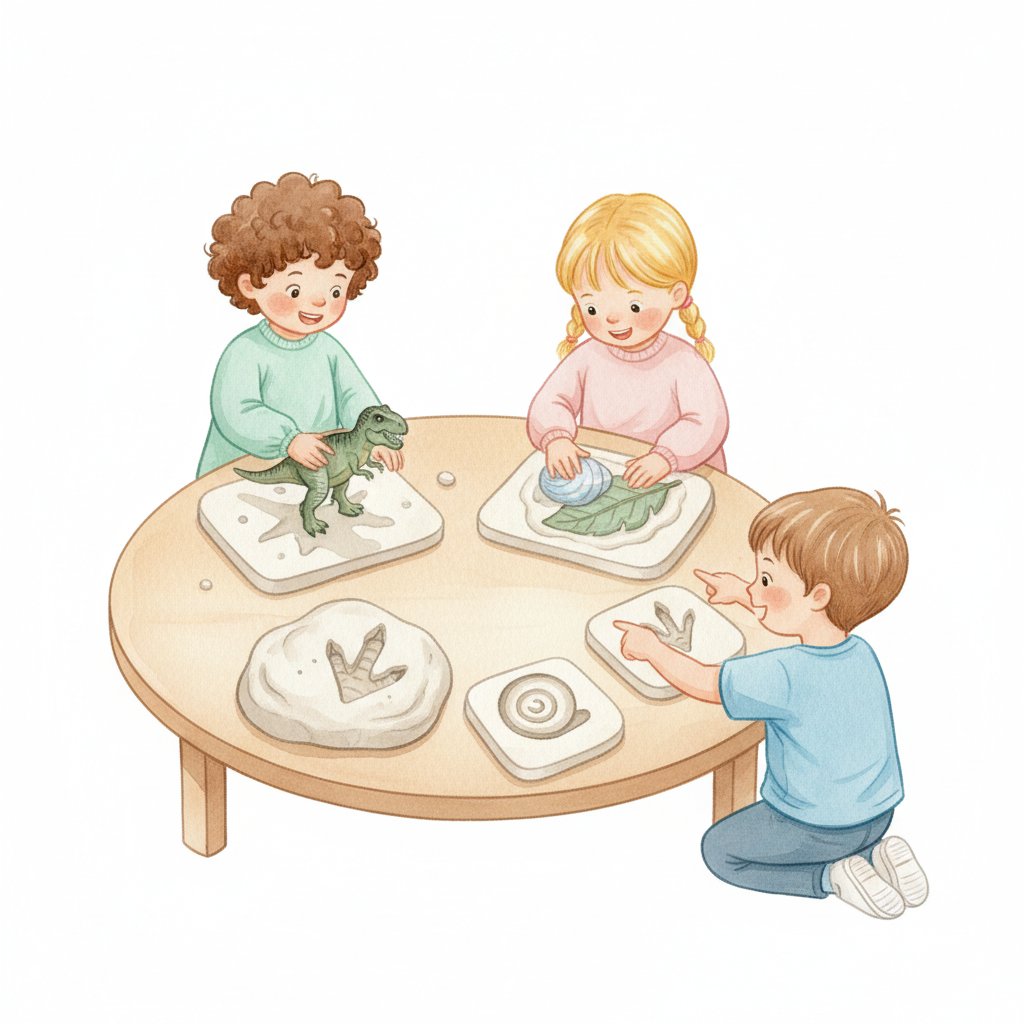
What to do: "Press the dinosaur foot into the clay. Look — a FOSSIL footprint! Now press a shell. Now a leaf." Compare: "Which print is deepest? Which is biggest?" The pressing teaches how fossils form. For more clay, see our playdough guide.

3. Dinosaur footprint comparison
Materials: Measuring tools, paper.

What to do: "A T-Rex footprint was as big as THIS (draw a 3-foot oval). A Compsognathus footprint was as big as THIS (draw a 2-inch oval). How many of YOUR feet fit in the T-Rex footprint?" The comparison teaches relative size. For more measuring, see our math guide.

4. Herbivore vs. carnivore sort
Materials: Dinosaur pictures, plant/meat pictures.

What to do: "Dinosaurs that eat PLANTS are herbivores. Dinosaurs that eat MEAT are carnivores. Look at the teeth: FLAT teeth=plant eater. SHARP teeth=meat eater." Sort the pictures. The sorting teaches classification through observable features. For more sorting, see our sorting guide.

5. Extinction discussion
What to do: "Dinosaurs lived a LONG time ago — before people, before ice cream, before houses! Then something happened and they all died. That is called EXTINCTION. But birds are actually dinosaur descendants — so dinosaurs aren't completely gone!" The discussion teaches deep time and biological connection. For more animals, see our pets and animals guide.

Farm animals have prehistoric cousins
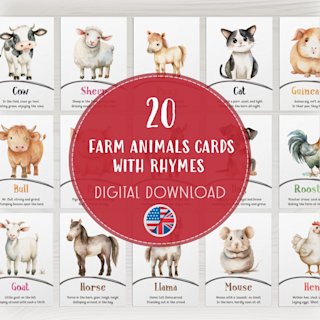
Our Farm Animals Flashcards spark a prehistoric conversation: 'Chickens are the CLOSEST living relatives of T-Rex! Seriously! Both walk on two legs, both have feet with three toes, both lay eggs, and both have a specific kind of hip bone. Cows are related to giant plant-eating dinosaurs called Sauropods — both eat plants all day long! Pigs are smart like dinosaurs were — some scientists think certain dinosaurs were as smart as pigs!' The flashcards connect familiar farm animals to their ancient cousins. 12 farm animals, 12 prehistoric connections, one deck that bridges past and present.

Dinosaur Movement and Play (Ages 3-6)

6. Dino movement
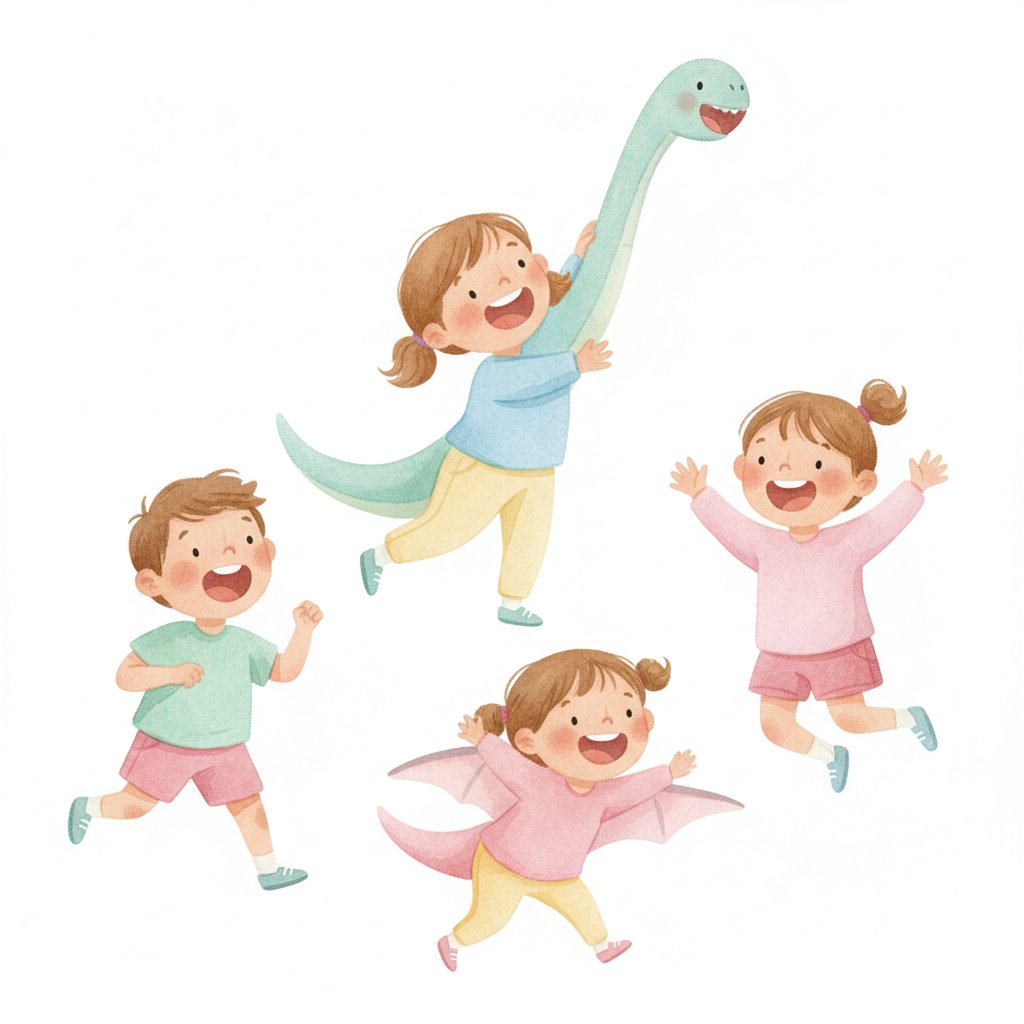
What to do: "T-Rex walks: short arms, BIG steps, ROAR! Brachiosaurus: stretch your neck UP HIGH to eat leaves from tall trees! Triceratops: stomp with three horns on your head! Pterodactyl: spread your wings and FLY! Stegosaurus: walk slowly with a heavy tail!" The movement teaches dinosaur anatomy through the body. For more movement, see our gross motor guide.

7. Dinosaur freeze dance
What to do: "Dance like a dinosaur! When the music stops, FREEZE in a dinosaur pose!" The freeze dance teaches self-regulation through a dinosaur lens. For more self-regulation, see our self-regulation guide.

8. Dinosaur egg balance
Materials: Ballons or plastic eggs, spoons.

What to do: "Carry the dinosaur egg on your spoon without dropping it! Dinosaurs were VERY careful with their eggs!" The balance teaches careful movement and fine motor control.

9. Volcano stomp
Materials: Pillows or mats.

What to do: "The volcano is erupting! Stomp across the lava rocks (pillows) without touching the floor (lava)!" The obstacle course teaches balance and gross motor skills. For more obstacle ideas, see our gross motor guide.

10. Dinosaur parade
What to do: "Line up! We're having a dinosaur parade! Tall dinosaurs in BACK, short dinosaurs in FRONT. Walk ROAR stomp ROAR!" The parade teaches size ordering and cooperative movement. For more cooperation, see our group games guide.

D is for Dinosaur, T is for T-Rex, P is for Paleontologist
Our Alphabet Monster Flashcards teach letters through dinosaur vocabulary: 'A is for ALLOSAURUS! B is for BRONTOSAURUS! D is for DIPLODOCUS! P is for PTERODACTYL! S is for STEGOSAURUS! T is for T-REX! V is for VELOCIRAPTOR!' Dinosaur names are LONG and COMPLEX — and preschoolers can say them perfectly because they LOVE them. A child who struggles to say 'banana' will confidently roar 'VELOCIRAPTOR!' Use that enthusiasm: each letter becomes a dinosaur. 26 letters, 26 prehistoric creatures, 26 reasons to love the alphabet.

Dinosaur Math and Art (Ages 3-6)

11. Dinosaur counting
Materials: Dinosaur counters.

What to do: "Count the T-Rexes: 1, 2, 3, 4, 5! Count the Triceratops: 1, 2, 3! Are there MORE T-Rexes or MORE Triceratops?" The counting teaches comparison through dinosaurs. For more counting, see our number guide.

12. Dinosaur patterns
Materials: Dinosaur counters.

What to do: "T-Rex, Triceratops, T-Rex, Triceratops — what comes NEXT? T-REX!" Create AB patterns, then ABC patterns: "Stego, Raptor, Bronto, Stego, Raptor, Bronto — what comes next?" The patterning teaches math through dino sequences. For more patterns, see our pattern guide.

13. Dinosaur size ordering
Materials: Dinosaur pictures of different sizes.

What to do: "Put the dinosaurs in order from SMALLEST to BIGGEST! Compsognathus — Velociraptor — Triceratops — T-Rex — Brachiosaurus!" The ordering teaches seriation and comparative vocabulary. For more size concepts, see our opposites guide.

14. Dinosaur skeleton art
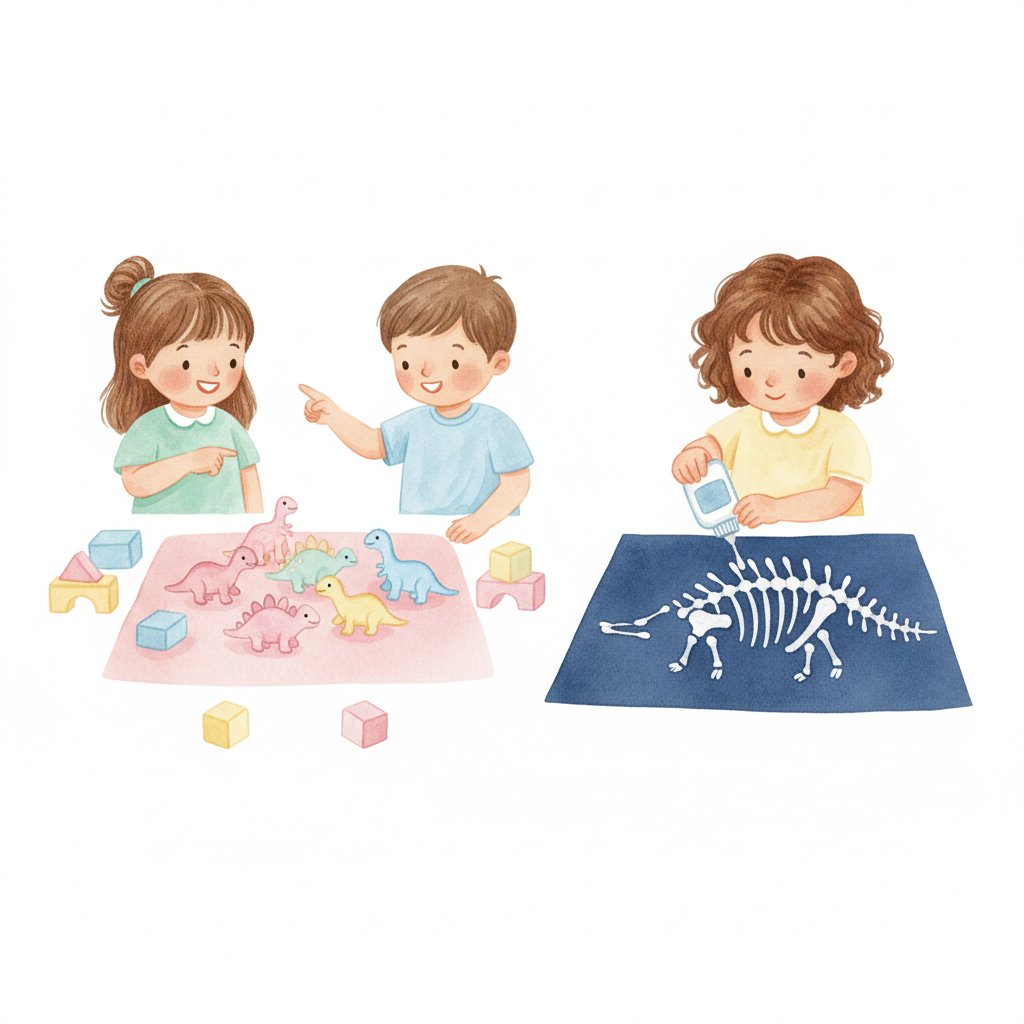
Materials: Q-tips, black paper, glue.

What to do: "Build a dinosaur skeleton with bones (Q-tips)! A skull, a spine, ribs, arm bones, leg bones, a tail!" The art teaches anatomy through creative construction.

15. Dinosaur habitat diorama
Materials: Shoe box, craft materials.

What to do: "Build a dinosaur world! Add water (blue paper), trees (green paper), volcanoes (brown clay), and your toy dinosaurs." The diorama teaches habitat and ecosystem concepts. For more habitats, see our earth day guide.

Dinosaur Learning Extensions (Ages 3-6)

16. Dinosaur timeline
What to do: "Dinosaurs lived in three time periods: Triassic (first — small dinosaurs), Jurassic (middle — BIG dinosaurs), Cretaceous (last — T-Rex!)." Create a simple timeline: "Then an asteroid hit the earth and... EXTINCTION." The timeline introduces the concept of deep time. For more time concepts, see our days of the week guide.

17. Dinosaur vocabulary
What to do: Teach key words: fossil, extinct, paleontologist, herbivore, carnivore, prehistoric. "Use each word in a sentence: 'A PALEONTOLOGIST found a FOSSIL of an EXTINCT dinosaur that was a HERBIVORE!'" The vocabulary builds scientific language. For more vocabulary, see our vocabulary guide.

18. Dinosaur story
What to do: "Tell a story about a dinosaur. Where does it live? What does it eat? What happens to it?" Children create narratives with prehistoric settings. For more storytelling, see our storytelling guide.

19. If dinosaurs were here today
What to do: "What if a T-Rex came to our school? Would it fit through the door? What would it eat for lunch? Could it ride the bus?" The imaginative discussion teaches size comparison and logical reasoning. For more imagination, see our imagination guide.

20. Dinosaur research book
Materials: Paper, crayons.

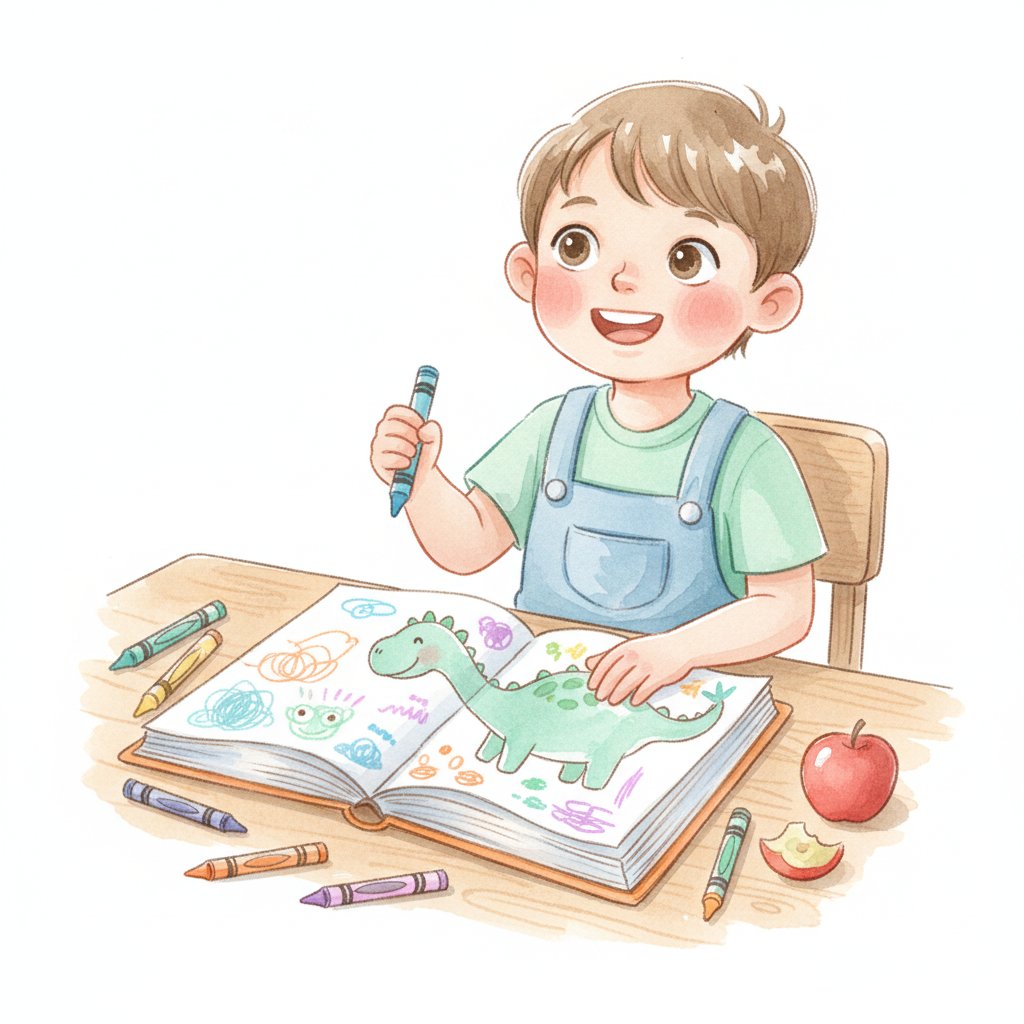
What to do: "Pick your favorite dinosaur. Draw it. What is its name? How big was it? What did it eat? Where did it live?" Compile into a class book. The research teaches early non-fiction writing. For more writing, see our writing guide.

A safari is a time machine
Our Safari Animals Art Activity Pack becomes a prehistoric journey: 'Imagine a safari 65 million years ago. Instead of elephants, you'd see MAMMOTHS. Instead of rhinos, you'd see TRICERATOPS. Instead of giraffes, you'd see BRACHIOSAURUS. Instead of cheetahs, you'd see VELOCIRAPTORS. The African savanna has the SAME kinds of animals today — big herbivores, fast carnivores, tall plant-eaters — but the dinosaurs were BIGGER, FASTER, and LOUDER.' After painting modern safari animals, children draw their prehistoric counterparts side by side. Same ecosystem, different era.
1.Why are preschoolers so obsessed with dinosaurs?
Dinosaurs hit a developmental sweet spot: they're REAL (not fantasy), they're HUGE (bigger than anything children know), they're DANGEROUS but EXTINCT (safe to explore), and they have LONG COMPLICATED NAMES that children love to master. Knowing dinosaur names gives preschoolers expertise that adults often lack — a rare feeling of competence that builds confidence. The obsession is actually a sign of healthy curiosity and cognitive development.
2.Are dinosaur activities educational or just fun?
Both — and that's the point. Dinosaur activities teach science (observation, classification, extinction), math (counting, size comparison, patterns), literacy (new vocabulary, letter sounds in dino names), art (drawing, sculpting), movement (stomping, stretching, roaring), and history (deep time, change over time). No other preschool topic integrates so many subject areas so naturally.
3.How accurate do dinosaur facts need to be for preschoolers?
Focus on the big ideas that are well-established: dinosaurs lived long ago, they came in many sizes and types, some ate plants and some ate meat, they went extinct, and birds are their descendants. Don't worry about naming 50 species or explaining continental drift. If children learn that scientists study fossils to learn about the past, that's the most important lesson.
4.What if a child is scared of dinosaurs?
Start with FRIENDLY dinosaurs: plant-eaters, baby dinosaurs, cartoon dinosaurs. "This baby Triceratops is eating LEAVES. It's just a baby — it's not scary, it's hungry!" Focus on the wonder, not the danger. Avoid showing T-Rex hunting scenes or loud roaring videos. Emphasize that dinosaurs are GONE — they can't hurt anyone anymore. Most fears fade once children understand extinction.