Articles6 min read

The Shadow That Changed Size
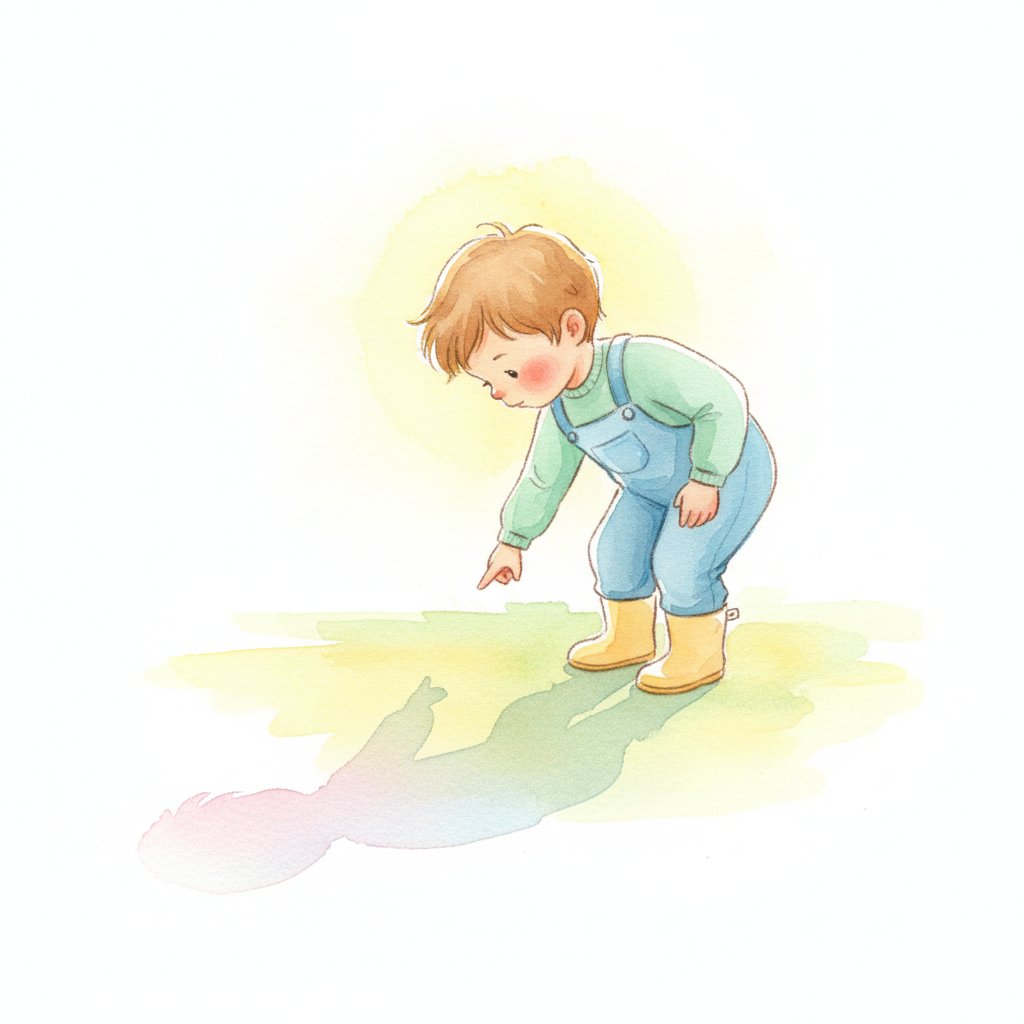
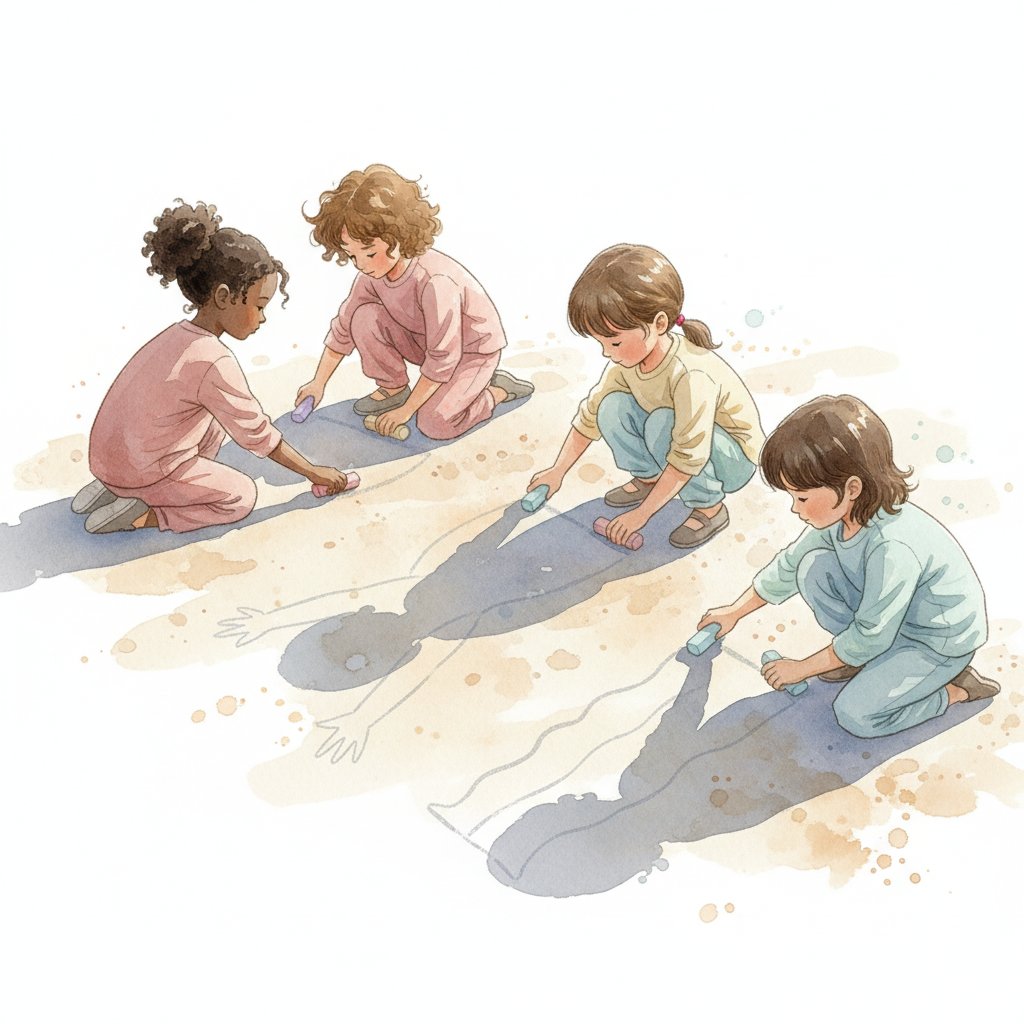
We were outside at noon. "Stand still," I said, and traced Leo's shadow with chalk. It was SHORT and WIDE. Three hours later, we went back outside and traced it again. His shadow was TALL and THIN. "What happened to my shadow?!" Leo asked. "It GREW!" I asked: "Where is the sun now compared to this morning?" He looked up. "It MOVED!" And just like that, a five-year-old understood that shadows change because the Earth rotates and the sun's angle changes. Not from a textbook, not from a diagram — from tracing his own shadow with chalk on the sidewalk, twice in one day. Light and shadow activities are the most ACCESSIBLE physics in the world: all you need is light and something to block it.

According to the National Science Teaching Association, light and shadow activities teach optics (how light travels, reflects, refracts), cause and effect (light source position determines shadow), geometry (shapes, angles, size relationships), and scientific observation (tracking changes over time).

This guide covers 20+ light and shadow activities for ages 3-6. Pair it with our science experiments guide for more science and our five senses guide for sight exploration.
Shadow Exploration Activities (Ages 3-6)

1. Shadow tracing
Materials: Chalk, sunny day.

What to do: "Stand still! I'll trace your shadow. Now YOU trace MINE! Look at the shapes we made!" Come back 2 hours later and trace again. "Your shadow got LONGER! Why? The sun moved!" The tracing teaches observation and measurement. For more measurement, see our math guide.

Why it works: Shadow activities are powerful because they make an INVISIBLE concept VISIBLE. Children can't see light rays or the Earth's rotation, but they CAN see their shadow changing shape and size. The shadow is EVIDENCE of physics happening in real time. And it's their OWN body creating the evidence — not a demonstration, not a video — their body.

2. Shadow size experiment
Materials: Flashlight, toy.

What to do: "Hold the flashlight close to the toy. The shadow is BIG. Move it far away. The shadow is SMALL! Light that is close makes BIG shadows, light that is far makes small shadows." The experiment teaches inverse size relationships.

3. Shadow shapes
Materials: Flashlight, various objects.

What to do: "Can you guess what made this shadow? A circle — is it a ball? A plate? A cup?" Hold objects between the light and wall. Children guess from the shadow shape. The guessing teaches shape recognition from silhouettes. For more shapes, see our shape guide.

4. Shadow dance
Materials: Flashlight in a dark room.

What to do: "Dance and watch your shadow dance too! Can you make your shadow TALL? SHORT? WIDE? Touch your shadow hands!" The dancing teaches body awareness and movement. For more movement, see our gross motor guide.

5. Shadow matching
Materials: Shadow pictures, object pictures.

What to do: "Match each shadow to the object that made it! The tree shadow goes with the tree. The house shadow goes with the house." The matching teaches visual discrimination. For more matching, see our matching guide.

Every shadow is a shape
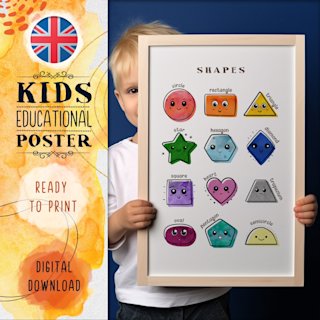
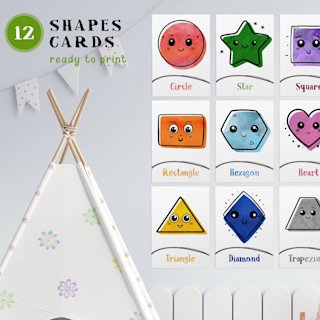
Our Shapes Flashcards decode shadow play: 'A ball makes a CIRCLE shadow. A book makes a RECTANGLE shadow. A pyramid block makes a TRIANGLE shadow. A pencil makes a long thin RECTANGLE shadow. A cup makes a CIRCLE shadow from above and a RECTANGLE shadow from the side!' After exploring shadows, hold up the flashcards: 'Which shape matches YOUR shadow?' Children learn that 3D objects create 2D shadow shapes — and different angles create different shapes. The same cup can make a circle OR a rectangle shadow. Physics meets geometry meets flashcard fun.

Shadow Puppets and Light Play (Ages 3-6)

6. Shadow puppet theater
Materials: Blanket or sheet, flashlight, paper cut-out puppets.

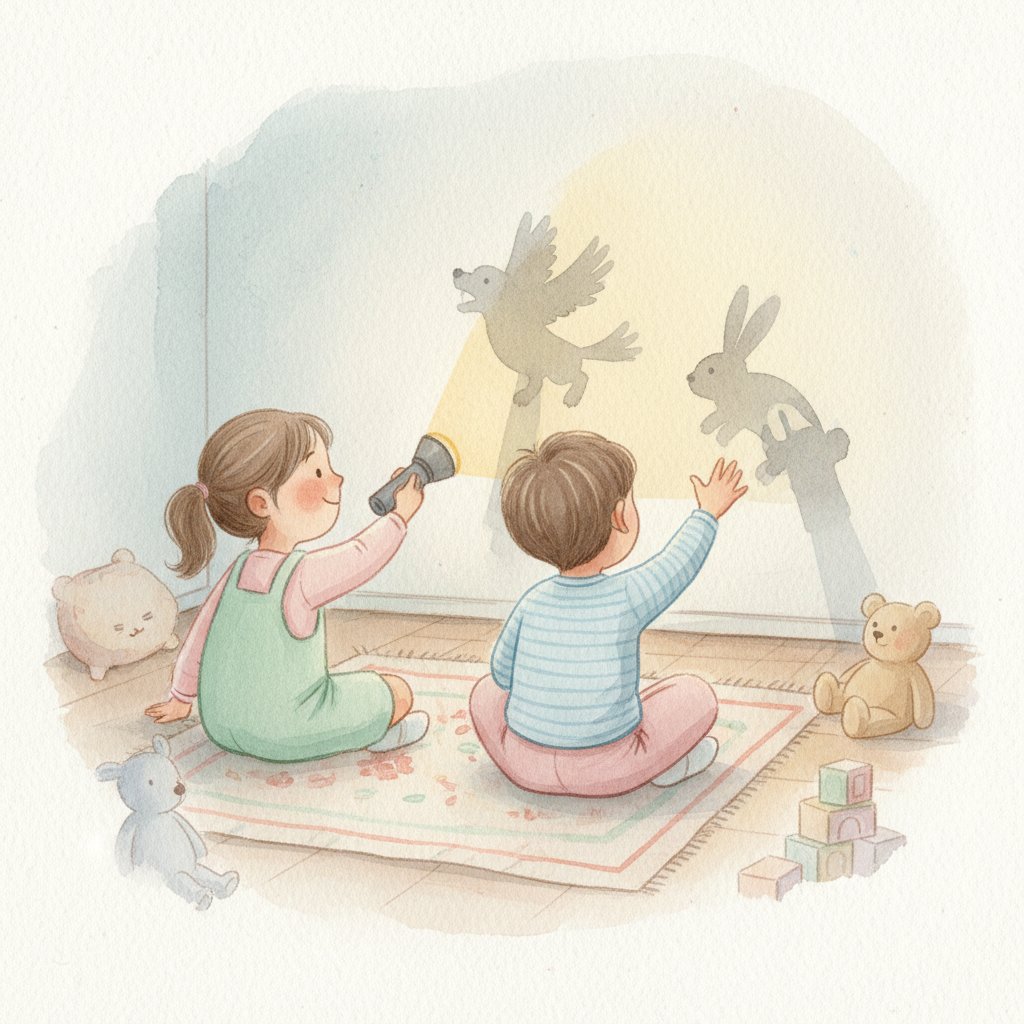
What to do: "Hang the sheet. Shine the flashlight. Hold your puppets between the light and the sheet. Tell a story!" The theater teaches storytelling and performance. For more storytelling, see our storytelling guide.

7. Hand shadow puppets
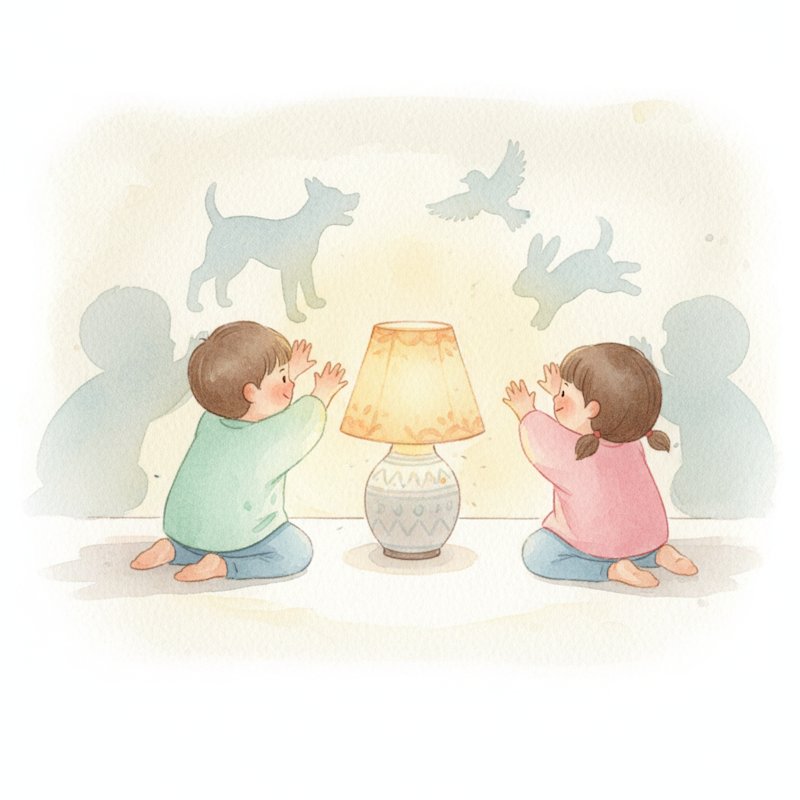
What to do: "Make a bunny: extend two fingers like ears. Make a dog: extend thumb and pinky. Make a bird: cross your thumbs and flap your hands. Make a monster: spread ALL your fingers!" The hand puppets teach fine motor control and imagination. For more imagination, see our imagination guide.

8. Shadow story sequencing
Materials: Cut-out story characters.

What to do: "Put the characters in order on the shadow stage: First, the bunny hopped to the garden. Then, the fox chased it. Then, the bunny hid behind a tree. Then, the fox went away!" The sequencing teaches narrative structure through shadow play. For more sequencing, see our fairy tales guide.

9. Transparent, translucent, opaque sort
Materials: Flashlight, various materials (glass, wax paper, cardboard, plastic wrap, tin foil, tissue paper).

What to do: "Shine the light through each material. Does ALL the light go through? SOME of the light? NONE of the light?" The sorting teaches material properties: transparent (all light), translucent (some light), opaque (no light). For more sorting, see our sorting guide.

10. Light through colored cellophane
Materials: Flashlight, colored cellophane sheets.

What to do: "Shine the light through RED cellophane — the light turns RED! Now BLUE — the light turns BLUE! What happens if you layer RED and BLUE? The light turns PURPLE!" The color mixing teaches that light colors blend differently than paint colors. For more colors, see our color guide.

Shadows have feelings too
Our Emotions Monster Feelings Flashcards become shadow puppets: 'Hold up the HAPPY monster. Make its shadow DANCE — happy shadows bounce and wave! Now hold up the SAD monster. Make its shadow droop — sad shadows hang low and move slowly. Now the ANGRY monster. Make its shadow STOMP — angry shadows are big and jerky!' Children project emotions onto their shadow puppets and practice expressing feelings through movement. The flashcards name the feeling; the shadow shows it in the body. 12 monsters, 12 feelings, 12 shadow performances.

Reflection and Refraction (Ages 3-6)

11. Mirror reflection
Materials: Mirror, small objects.

What to do: "Put a toy in front of the mirror. It looks like there are TWO toys! But one is a REFLECTION — light bounced off the mirror back to your eyes." The mirror teaches reflection. For more body awareness, see our body parts guide.

12. Mirror symmetry
Materials: Mirror, paper with half-drawings.

What to do: "Put the mirror on the fold line. The mirror completes the picture! Half a heart becomes a WHOLE heart. Half a butterfly becomes a WHOLE butterfly." The symmetry teaches geometric reflection. For more shapes, see our shape guide.

13. Water prism
Materials: Glass of water, flashlight.

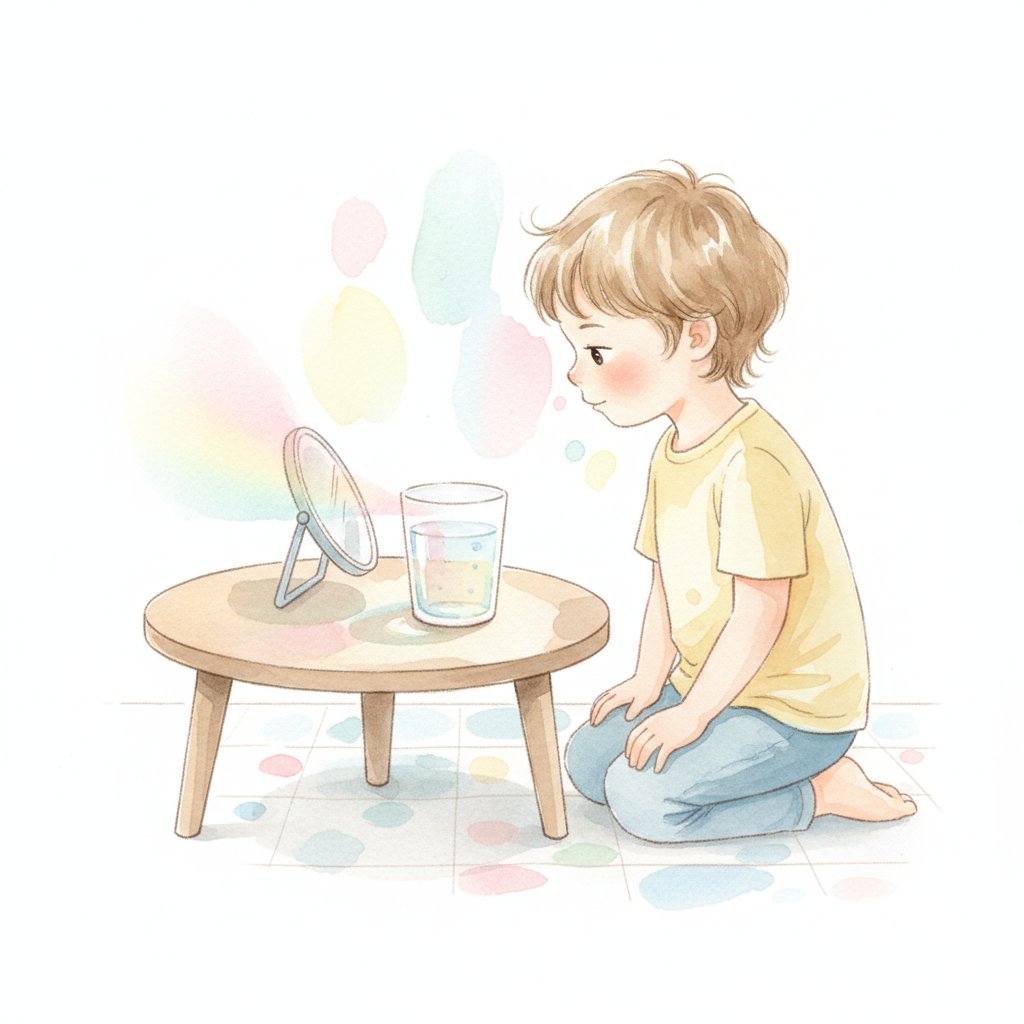
What to do: "Shine the flashlight through the water onto white paper. Do you see a RAINBOW? The water bends the light and splits it into colors!" The prism teaches refraction and color spectrum. For more colors, see our color guide.

14. Periscope play
Materials: Two small mirrors, cardboard tube.

What to do: "Angle the mirrors so you can see OVER the table while sitting UNDER it. The light bounces off one mirror to the other and into your eyes!" The periscope teaches reflection angles. For more engineering, see our block guide.

15. Light bounce maze
Materials: Several small mirrors.

What to do: "Aim the flashlight at a mirror. The light BOUNCES to the next mirror. Can you bounce the light around a corner?" The maze teaches angle of incidence equals angle of reflection. For more mazes, see our problem-solving guide.

More Light and Shadow Activities (Ages 3-6)

16. Shadow clock
Materials: Stick in the ground, chalk.

What to do: "Put a stick in the ground. Mark where the shadow points at 9am, 10am, 11am, 12pm. The shadow MOVED! Ancient people used shadows to tell time." The shadow clock teaches time and Earth's rotation. For more time, see our days of the week guide.

17. Light and dark art
Materials: Black paper, white chalk.

What to do: "Draw on BLACK paper with WHITE chalk. It looks like shadows on a dark wall! What can you draw? A nighttime city? A bat? Stars and a moon?" The art teaches contrast and light/dark concepts. For more art, see our art guide.

18. Shadow alphabet
Materials: Flashlight, letter blocks.

What to do: "Hold up a letter block. Can you read its shadow? Which letter made THIS shadow?" The alphabet shadows teach letter recognition through a new perspective. For more alphabet, see our alphabet guide.

19. Night and day discussion
What to do: "When it's daytime HERE, it's nighttime on the other side of the world. The sun doesn't move — the EARTH turns! When our side faces the sun, it's day. When it faces away, it's night." The discussion connects shadows to astronomy. For more space, see our space guide.

20. Light scavenger hunt
What to do: "Find: something that makes its OWN light (lamp, sun, candle). Something that REFLECTS light (mirror, spoon, water). Something that BLOCKS light (wall, book, your body). Something that lets light THROUGH (window, glass, water)." The scavenger hunt teaches categorization of light interactions. For more categorization, see our sorting guide.

Shadows tell time, posters track days
Our Days of the Week Poster connects shadow science to calendar learning: 'Every day, the sun rises and your shadow stretches long. Every noon, the sun is high and your shadow is short. Every evening, your shadow stretches long again. Seven days of shadows, seven days of the week.' The poster teaches that EVERY day has a shadow pattern — morning long, noon short, evening long — and that pattern repeats every day, Monday through Sunday. The sun's daily journey IS the calendar. Shadows are the clock. The poster is the schedule.
1.Do I need special equipment for light activities?
No. Most activities in this guide use a flashlight, sunshine, and everyday objects. A small mirror, a glass of water, and some chalk cover most of the experiments. Optional but nice: a light table (or a clear plastic storage bin with a flashlight underneath), colored cellophane sheets, and a simple sheet for shadow puppet theater. Total investment: under $15 for everything.
2.How do I explain light to a preschooler?
Use simple analogies: "Light is like invisible energy that travels in straight lines from a source like the sun or a flashlight. When light hits something, it can BOUNCE off (reflection), go THROUGH (transparency), or get BLOCKED (shadow). Your eyes are light catchers — they collect the light that bounces off things so you can SEE them. Without light, everything is dark and you can't see anything."
3.Can shadow play really teach science?
Absolutely. Shadow play teaches: (1) Light travels in straight lines — shadows prove it. (2) The position of the light source determines shadow size and direction. (3) Opaque materials block light; transparent materials let it through. (4) The Earth's rotation causes shadows to change throughout the day. (5) Color mixing with light is different from color mixing with paint. These are all NGSS (Next Generation Science Standards) physical science concepts appropriate for early elementary.
4.What about safety with flashlights?
Teach the ONE rule: "Never shine a flashlight in anyone's eyes." Use LED flashlights (they don't get hot). Supervise children under 4 who might not understand the eye-safety rule. For light-table activities, use a battery-powered LED light pad (cool to touch) rather than a hot lamp. Never use laser pointers with preschoolers — even brief exposure can damage retinas.