Articles7 min read

The 45-Minute Science Lesson That Started With a Puddle

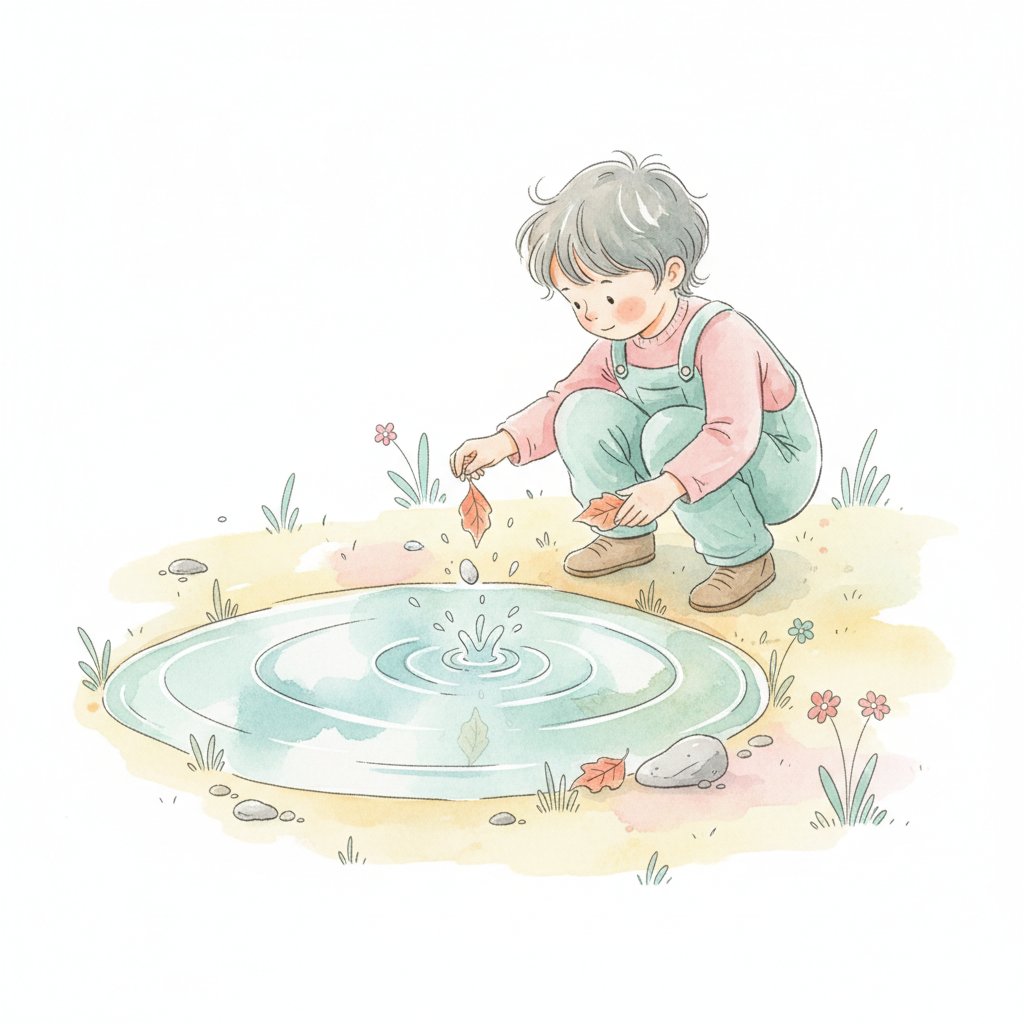
After a rainstorm, my daughter found a puddle on the sidewalk. She threw a pebble in. Splash. Then a leaf. It floated. Then a stick. It sank. Then a rock. Big splash. She started experimenting systematically — big rock vs. small rock, green leaf vs. brown leaf, fast throw vs. slow drop. For 45 minutes, a 4-year-old conducted experiments in density, displacement, velocity, and observation — all from a puddle.

This is what outdoor play does. The natural world is the richest, most responsive, most engaging classroom available — and it's free. According to the American Academy of Pediatrics, children who play outdoors regularly show improved motor fitness, better attention, reduced stress, and stronger creative thinking compared to children who spend most of their time indoors.
This guide covers 20+ outdoor activities for ages 3-6, organized by type: nature exploration, active games, creative outdoor play, and garden learning. Pair it with our science experiments for indoor investigations, our gross motor activities for movement, and our sensory activities for tactile play.
Why Outdoor Play Matters (The Research)

Physical benefits:

  • Large-scale movement (running, climbing, jumping) builds gross motor skills more effectively than any indoor activity
  • Uneven outdoor surfaces develop balance and proprioception
  • Sunlight exposure supports vitamin D production and circadian rhythm regulation

Cognitive benefits:

  • Open-ended natural materials (sticks, rocks, water) stimulate more creative play than single-purpose toys
  • Outdoor exploration develops scientific thinking: observation, hypothesis, testing
  • Natural settings restore attention and reduce mental fatigue

Social-emotional benefits:

  • Children self-regulate better after outdoor play — teachers report significantly fewer behavior problems on outdoor days
  • The larger space reduces social conflicts (more room=fewer territorial disputes)
  • Risk-taking in a supervised outdoor environment builds confidence and resilience
Indoor PlayOutdoor PlayWhy It Matters
Small movementsLarge movementsGross motor development
Single-purpose toysOpen-ended materialsCreativity
Flat surfacesUneven terrainBalance
Controlled environmentVariable conditionsAdaptability
Limited spaceUnlimited spaceSocial harmony

How much outdoor time? The AAP recommends at least 60 minutes of active outdoor play daily for preschoolers. Many early childhood programs aim for 2-3 hours per day. The activities below help make that time rich with learning.

Check the weather, then head outside
Our Weather Flashcards make outdoor time a daily decision: 'What's the weather today? Sunny? Perfect for sidewalk chalk! Rainy? Perfect for puddle jumping! Windy? Perfect for kite running!' Every weather condition is an outdoor activity opportunity — you just need the right gear and the right attitude. 12 weather cards, 12 outdoor adventure prompts.

Nature Exploration Activities (Ages 3-6)

1. Nature scavenger hunt
Materials: Scavenger hunt list (pictures for non-readers), bag for collecting.

What to do: Give children a list of items to find: something smooth, something rough, something green, something brown, something round, something long. Children search and collect.

Why it works: Scavenger hunts teach observation and categorization — children must look carefully and decide whether an object meets the criteria. "Is this smooth enough? Is this round enough?" For more observation skills, see our science experiments guide.

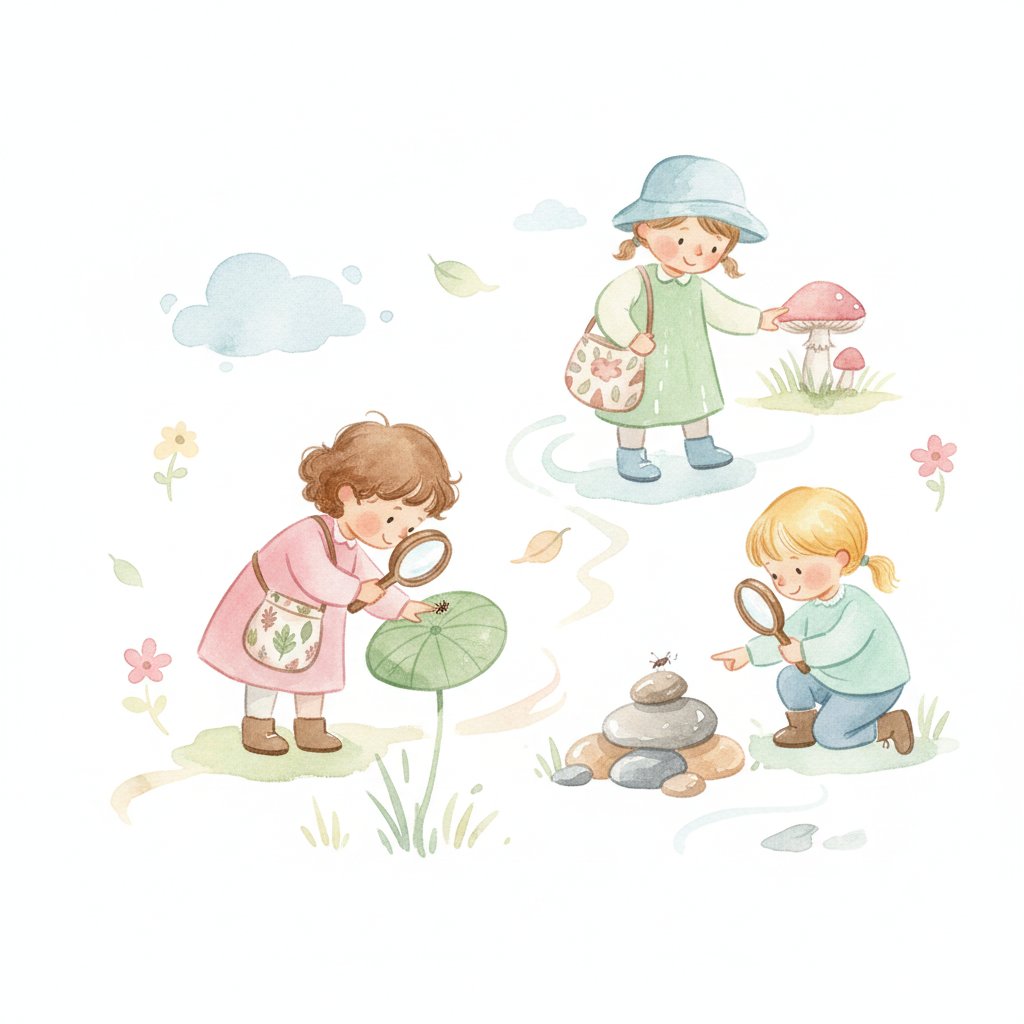
2. Bug observation
Materials: Magnifying glass, bug box (optional).

What to do: Children search for bugs under rocks, leaves, and logs. When they find one, they observe: "How many legs? What color? How does it move?" Observe and release.

3. Cloud watching
What to do: Lie on the grass and look at clouds. "What does that cloud look like? A dragon? A rabbit? A boat?" Cloud watching develops imagination and visual-spatial thinking. No materials needed.

4. Nature color hunt
Materials: Paint chip cards in various colors.

What to do: Children try to find something in nature that matches each paint chip color. "Find something that matches this green. Find something that matches this brown." Nature has more colors than most children realize. For more color activities, see our color guide.

5. Tree bark rubbing
Materials: Paper, crayons.

What to do: Hold paper against tree bark and rub with a crayon. Each tree species has a different bark pattern. Compare rubbings: "How is the oak bark different from the birch bark?" Texture exploration meets scientific observation.

Active Outdoor Games (Ages 3-6)

6. Sidewalk chalk obstacle course
Materials: Sidewalk chalk.

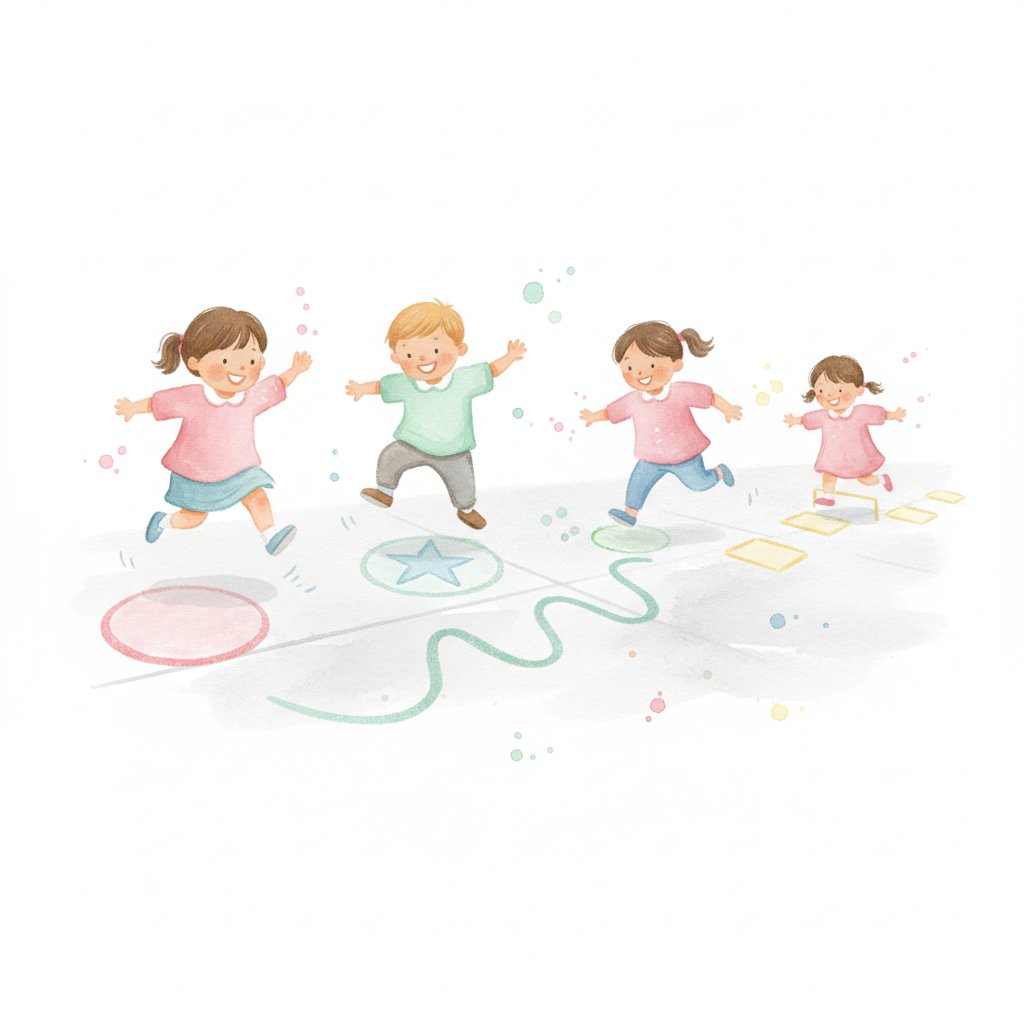
What to do: Draw an obstacle course: zigzag lines to walk, circles to hop in, arrows to follow, a "freeze" zone, a spin zone. Children run the course. Time them: "Can you beat your own time?"

Why it works: The course is visual, self-directed, and infinitely modifiable. Children can design their own courses, combining gross motor skills with creativity. For more movement, see our gross motor guide.

7. Shadow tag
What to do: Instead of tagging bodies, tag shadows! Children try to step on each other's shadows. The game requires spatial awareness and quick direction changes.

8. Red light, green light variations
What to do: Classic game with academic twists. "Green light — WALK. Red light — FREEZE. Yellow light — TIP TOE. BLUE light — HOP!" Adding colors and movements turns a simple game into a listening and following-directions workout.

9. Balance beam logs
Materials: Logs or planks on the ground.

What to do: Children walk across logs or planks as balance beams. The slightly unstable surface engages core muscles and balance systems in ways flat indoor surfaces can't.

10. Parachute with leaves
Materials: Play parachute or large sheet.

What to do: Pile autumn leaves on the parachute. Children shake and bounce to launch the leaves. "Make a leaf storm! Make a leaf tornado!" The cooperative shaking + the visual spectacle of flying leaves=pure joy.

Take the safari outside
Our Safari Animals Art Activity Pack transforms the backyard into a wildlife reserve: hide the animal cards around the yard, children go on safari to find them, then identify each animal. 'I found the lion! Lions live in the savanna!' Outdoor scavenger hunt meets animal science meets dramatic play. 12 animals, one backyard safari.

Creative Outdoor Play (Ages 3-6)

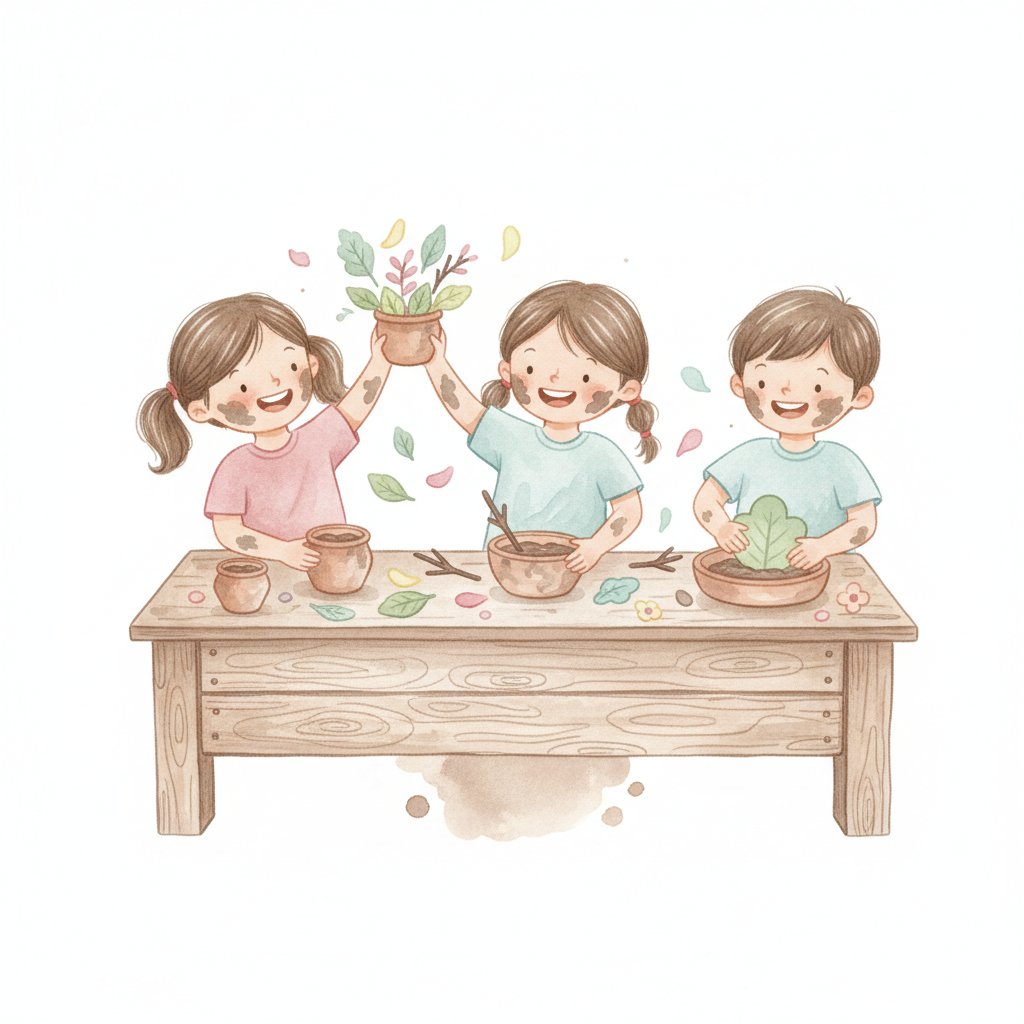
11. Mud kitchen
Materials: Old pots, pans, spoons, bowls, water source, dirt.

What to do: Children create "food" from mud, water, leaves, and petals. "I'm making mud soup with three leaves and five pebbles!" The counting, measuring, and recipe-following are math in disguise.

Why it works: Mud play is one of the richest sensory experiences available — tactile (texture of mud), olfactory (earth smell), visual (color mixing), and proprioceptive (the weight and resistance of mud). For more sensory play, see our sensory activities guide.

12. Nature art
Materials: Collected natural materials, glue, paper or cardboard.

What to do: Children create collages and pictures using leaves, petals, pebbles, seeds, and twigs. "Make a face with acorn eyes, a leaf nose, and a twig mouth." For more art ideas, see our art activities guide.

13. Outdoor painting with water
Materials: Buckets of water, large paintbrushes.

What to do: Children "paint" the sidewalk, fence, or wall with water. The water creates dark marks that evaporate in the sun. No mess, no supplies to buy, infinite canvas.

14. Fairy garden building
Materials: Small natural materials, a designated garden space.

What to do: Children build miniature worlds: stick fences, pebble paths, leaf roofs. The small-scale construction requires fine motor precision in an outdoor setting. For more building, see our block activities guide.

15. Sound mapping
Materials: Paper, markers.

What to do: Children sit quietly outside for 2 minutes, listening. Then they draw a "sound map" — putting themselves in the center and drawing what they heard and where. "A bird was there. A car was there. Wind was everywhere." This is scientific observation through a different sense.

Garden and Water Play (Ages 3-6)

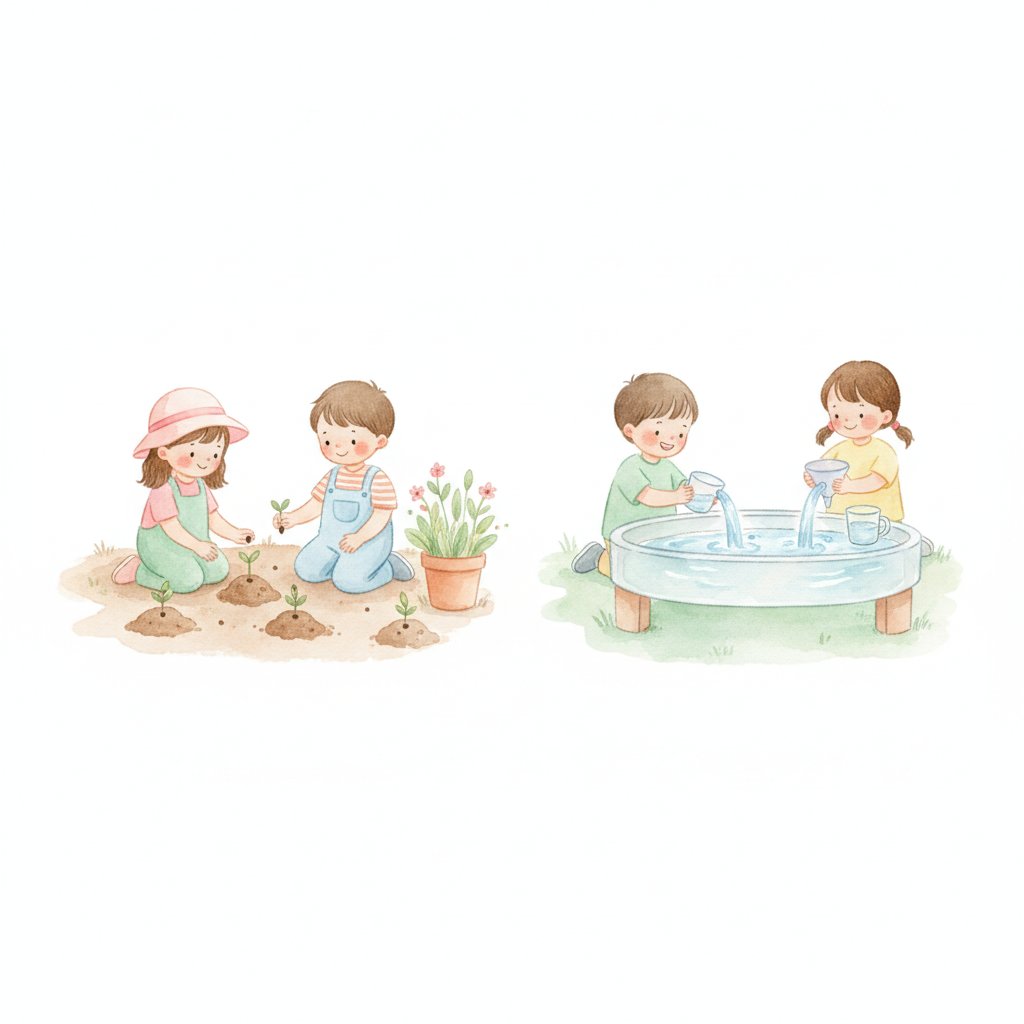
16. Planting seeds
Materials: Seeds, soil, pots or garden space, water.

What to do: Children plant seeds and care for them. "Push the seed down to your first knuckle. Cover with dirt. Water gently." Track growth on a chart: "How many days until it sprouts?"

Why it works: Growing plants teaches patience, care, and the scientific method: observe, predict, wait, observe again. Children who grow their own food are more likely to eat vegetables. For more science, see our science experiments guide.

17. Water table physics
Materials: Water table or large bin, funnels, tubes, cups, sieves, boats.

What to do: Children explore how water moves: pouring through funnels, filling and emptying containers, floating and sinking objects, directing flow through tubes. "Does the boat go faster in deep water or shallow water?"

18. Dinosaur dig
Materials: Sandbox, plastic dinosaurs or bones, paintbrushes.

What to do: Bury dinosaurs in sand. Children use paintbrushes to carefully excavate them. "Brush slowly so you don't damage the fossil!" The patience required for excavation teaches careful fine motor control.

19. Sponge relay
Materials: Sponges, two buckets per team, water.

What to do: Children soak a sponge in one bucket, run to the other, and squeeze it out. First team to transfer all the water wins. The soaking and squeezing build hand strength. For more hand activities, see our fine motor guide.

20. Outdoor reading fort
Materials: Blankets, chairs, clips, books.

What to do: Build a simple fort in the yard. Fill it with pillows and books. Children read (or look at books) in their outdoor reading nook. The novelty of reading outside makes it special.

Your body was built for the outdoors
Our Human Body Poster shows the muscles, bones, and joints children use when they run, climb, jump, and balance outside. 'When you climb that log, your arm muscles are working! When you balance on the beam, your core is engaged!' Understanding what their body is doing outdoors makes children more intentional movers. Anatomy meets adventure.
1.How much outdoor time should preschoolers get each day?
The American Academy of Pediatrics recommends at least 60 minutes of active outdoor play daily, though many early childhood experts recommend 2-3 hours. This doesn't need to be continuous — two 45-minute outdoor sessions (morning and afternoon) work well in most programs. In extreme weather, even 15-20 minutes of outdoor time is better than none.
2.What if I don't have a yard or playground nearby?
Sidewalks, parks, parking lots (when empty), community gardens, and even balconies can be outdoor play spaces. Nature scavenger hunts work on city sidewalks (find a crack in the pavement, something growing between the bricks, a puddle). The key is getting outside — the specific space matters less than the openness and fresh air.
3.Is it safe to let preschoolers play in the rain or snow?
Yes, with proper gear. Rain gear (boots, raincoat, extra socks) makes rainy days the best outdoor days — puddles, worms, streams, and mud are rich learning materials. Snow gear (waterproof mittens, boots, layers) enables snow play. The Scandinavian saying "There's no bad weather, only bad clothing" is the right mindset. Monitor for safety, but don't let weather eliminate outdoor time.
4.How do I manage a group of preschoolers outside?
Establish clear outdoor boundaries before going out. Use consistent signals (whistle, call-and-response) for gathering. Position adults at high-risk areas (climbing equipment, gates). Give children more freedom than indoors — the larger space allows it. Bring a first-aid kit. And accept that outdoor play is louder, messier, and more active than indoor play — that's the point.