Articles6 min read

The Tree Pose That Taught Balance

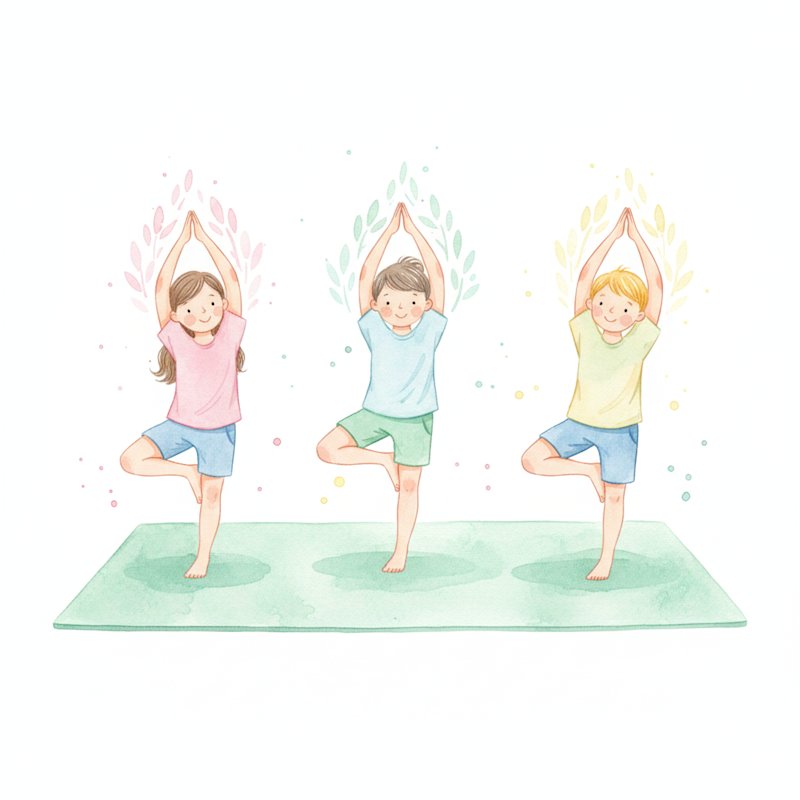
"Stand on one foot. Now put your other foot on your calf. Arms up like branches. You're a TREE." Five four-year-olds wobbled, tipped, and fell over. Giggling. They got up and tried again. By the third try, Leo held it for 5 seconds. "I'm a tree and I'm NOT falling!" Then Mia bumped him and they both collapsed in laughter. "Trees don't bump each other!" Leo protested. "Actually," I said, "in a storm, trees DO bump. But their ROOTS keep them grounded." He tried again, wiggling his toes into the mat: "I'm making roots!" Yoga for preschoolers is not about perfect poses or spiritual practice — it's about body awareness, balance, focus, and the joy of moving your body in new ways. And it turns out, children are NATURALS at it.

Research published in the Journal of Child and Family Studies shows that preschool yoga improves balance, coordination, focus, self-regulation, and even sleep quality. Children who practice yoga show 37% better balance scores and significantly improved classroom behavior compared to control groups.
This guide covers 20+ yoga and stretching activities for ages 3-6. Pair it with our calming strategies guide for self-regulation and our gross motor guide for more movement.

Animal Yoga Poses (Ages 3-6)

1. Cat and cow
What to do: "On your hands and knees. Arch your back UP like an angry CAT. Now drop your belly DOWN like a lazy COW. Cat... cow... cat... cow." The arch-and-drop teaches spinal flexibility. For more animals, see our pets guide.

Why it works: Preschool yoga works because children IMAGINE they are animals rather than trying to execute perfect poses. "Be a cat!" is more effective than "Flex your spine posteriorly." The imagination engages their WHOLE brain — motor planning, visualization, and joy all activate simultaneously.

2. Downward dog
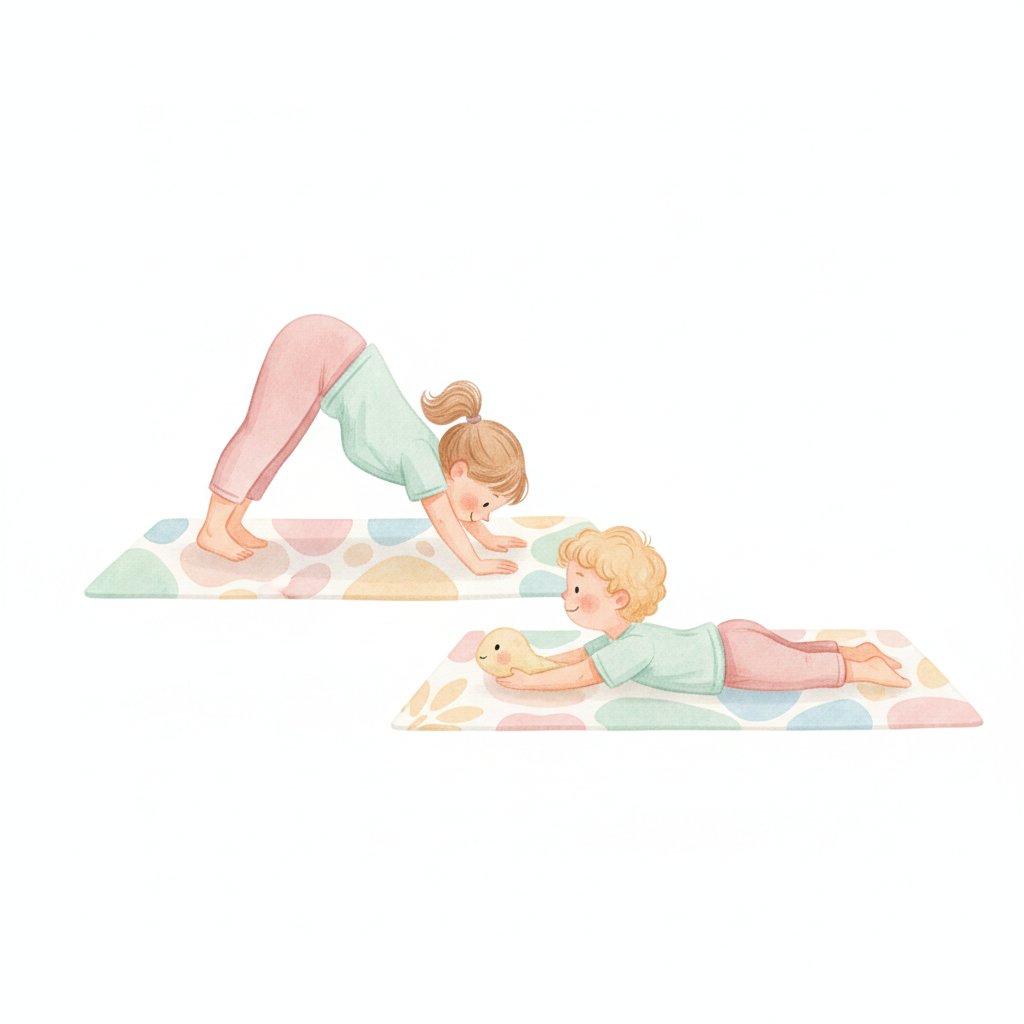
What to do: "Make an upside-down V with your body. Hands on the ground, bottom up HIGH. You're a dog stretching after a nap! Wag your tail!" The inverted V stretches hamstrings and shoulders.

3. Cobra snake
What to do: "Lie on your tummy. Put your hands under your shoulders. Push up! Lift your chest! You're a COBRA rising from the basket. Hissssss!" The cobra stretches the abdomen and strengthens the back.

4. Butterfly pose
What to do: "Sit down. Put the bottoms of your feet together. Let your knees fall open like butterfly WINGS. Flap your wings gently!" The butterfly stretches inner thighs and hips. For more insects, see our insects guide.

5. Lion pose
What to do: "Kneel down. Take a BIG breath. Now stick out your tongue and ROAR! Let all your energy OUT!" The lion pose releases tension and teaches breath-to-sound expression.

Every farm animal is a yoga pose
Our Farm Animals Flashcards become yoga pose cards: 'CAT — arch your back like a cat. COW — drop your belly like a cow. HORSE — stand tall and strong like a horse. CHICKEN — tuck your arms in and peck the ground. PIG — roll in the mud (wiggle on the floor). SHEEP — get on all fours and graze.' Pick a card, do the pose! The flashcards turn yoga into a game: draw an animal, become the animal, hold the pose. 12 farm animals, 12 yoga poses, 12 ways to stretch and play. Animal yoga meets flashcard fun.

Balance and Strength Poses (Ages 3-6)

6. Tree pose
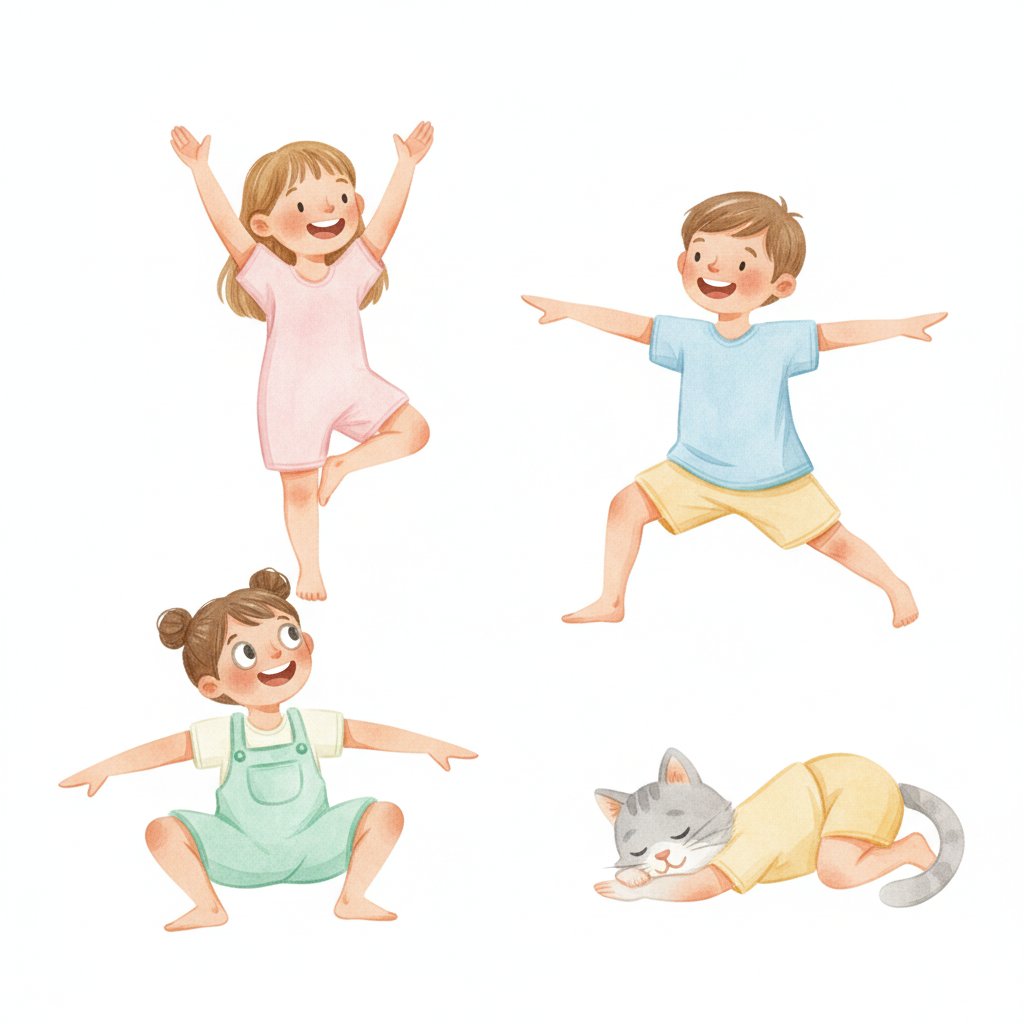
What to do: "Stand on one foot. Put your other foot on your calf. Arms UP like branches. You're a TREE growing tall. Can you hold it for 5 seconds?" The tree teaches single-leg balance. For more body control, see our gross motor guide.

7. Airplane
What to do: "Stand on one foot. Lean forward. Arms out to the sides like AIRPLANE WINGS. Hold it! You're flying!" The airplane teaches balance with a forward lean.

8. Bear walk
What to do: "Walk on your hands and feet with your bottom UP. You're a bear walking through the forest. Walk SLOW and careful." The bear walk builds core and upper body strength.

9. Flamingo
What to do: "Stand on one foot. Hold your other foot behind you. Arms out for balance. You're a FLAMINGO standing in the water. How long can you hold it?" The flamingo teaches posterior balance.

10. Turtle
What to do: "Sit on your bottom. Tuck your knees to your chest. Wrap your arms around your legs. Put your head down. You're a TURTLE in its shell. Stay still and quiet for 10 seconds." The turtle teaches stillness and body compression. For more calming, see our calming strategies guide.

Safari animals are the wildest yoga teachers
Our Safari Animals Art Activity Pack adds wild yoga poses to your routine: 'LION — kneel, breathe deep, stick out your tongue and ROAR! ELEPHANT — stand tall, clasp hands in front like a trunk, swing side to side. GIRAFFE — stand on tiptoes and reach as HIGH as you can. ZEBRA — gallop in place, high knees. CHEETAH — run in place as FAST as you can, then FREEZE.' Paint your safari animals in the morning, BECOME them in the afternoon. Art meets movement, learning meets play. One pack, two activities, five wild yoga poses.

Mindful Stretching and Breathing (Ages 3-6)

11. Star stretch
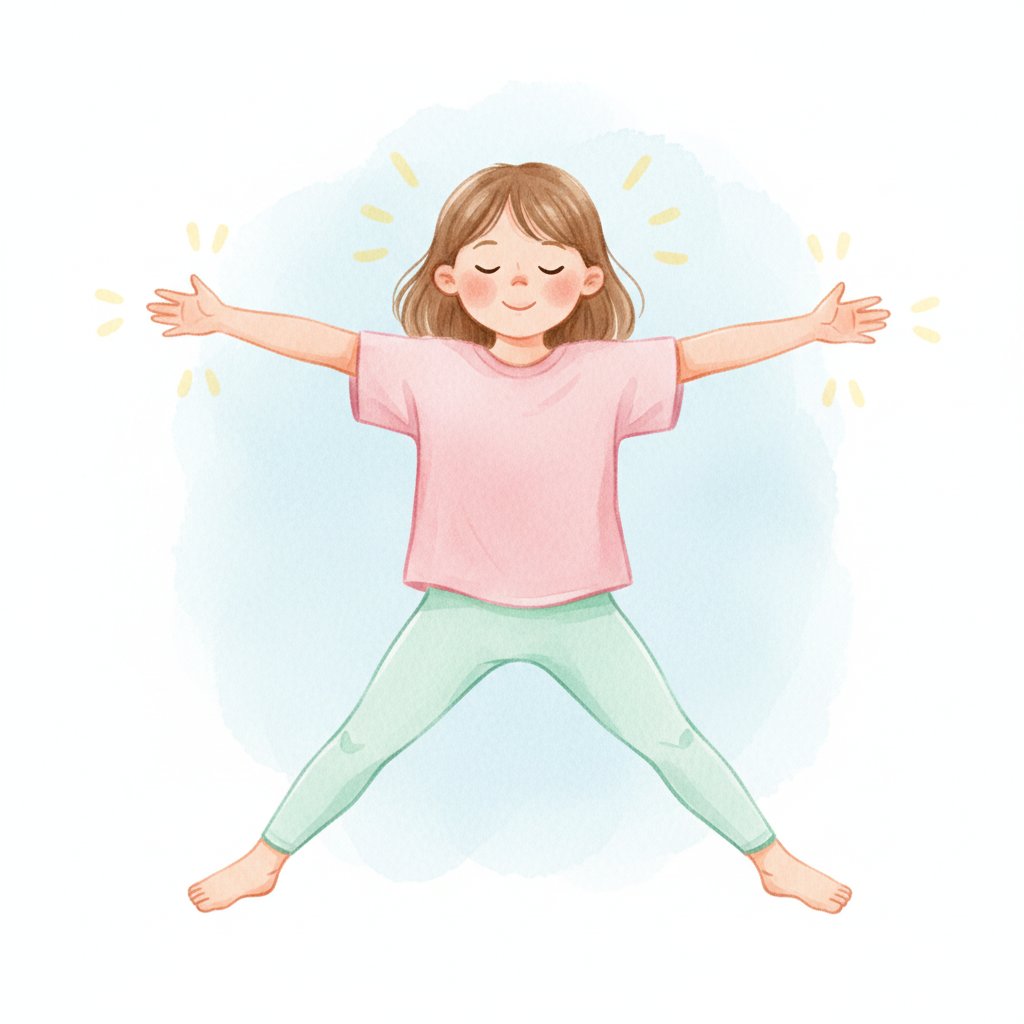
What to do: "Stand with your legs apart and arms out wide. You're a STAR! Stretch your right hand down to your right foot. Now the other side. Reach UP to the sky. Reach DOWN to your toes." The star stretches the whole body. For more body awareness, see our body parts guide.

12. Balloon breathing with movement
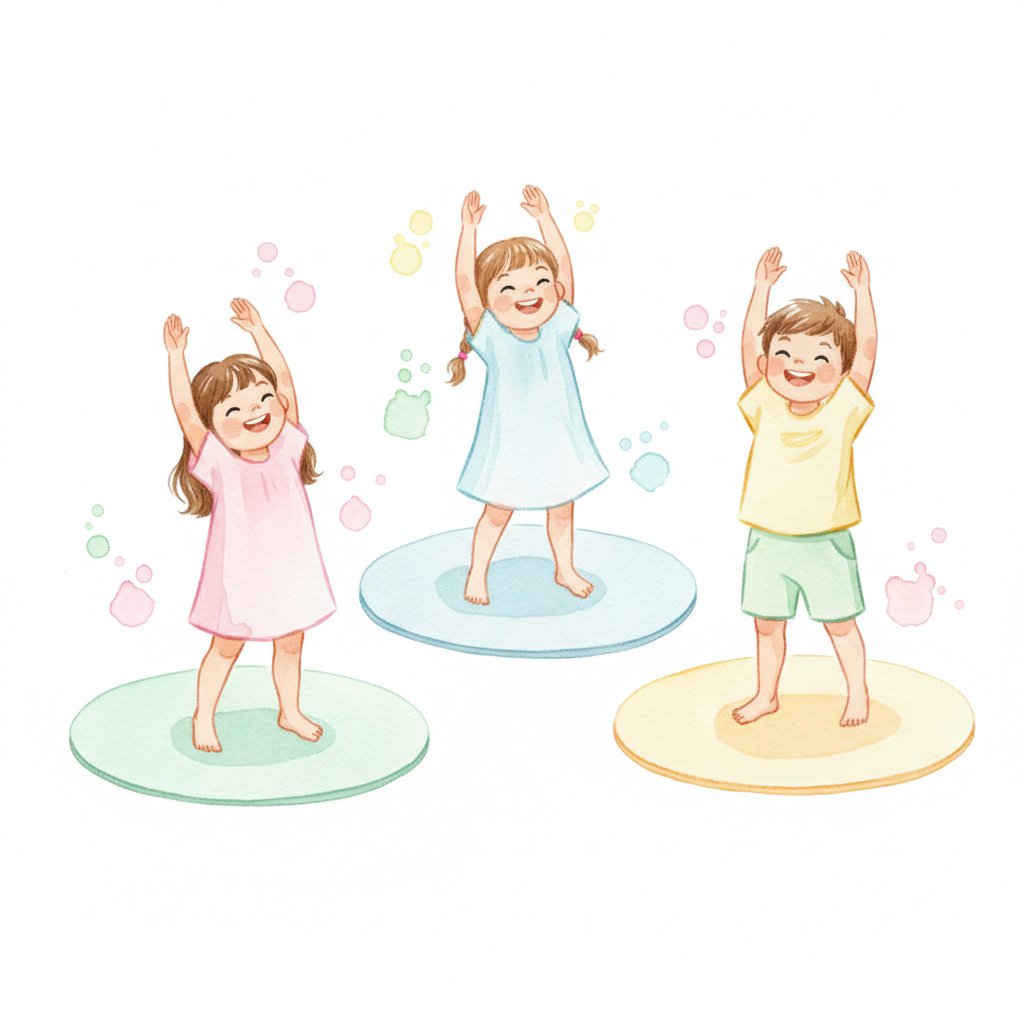
What to do: "Breathe in and make your arms go UP like a balloon filling with air. Breathe out and let your arms float DOWN like a balloon losing air." The breathing-with-movement connects breath to body.

13. Rainbow stretch
What to do: "Reach your right hand over your head to the left side. You're drawing a rainbow! Now the left hand over to the right side. Make the whole arch!" The rainbow stretches the sides of the body.

14. Spaghetti toes
What to do: "Sit down. Point your toes like pencils. Now FLEX them back. Curl them up. Spread them WIDE. Wiggle each toe!" The toe exercises build foot awareness and fine motor control.

15. Partner mirror stretch
What to do: "Face your partner. One person moves SLOWLY and the other copies exactly — like a mirror! Stretch up, bend sideways, twist gently." The mirroring teaches body awareness and social connection. For more social skills, see our social skills guide.

Yoga Games and Extensions (Ages 3-6)

16. Yoga story
What to do: "Once there was a CAT (cat pose) who met a DOG (downward dog). They walked through the FOREST (tree pose) and saw a SNAKE (cobra). A LION roared (lion pose)! They ran like a HORSE (gallop) and hid like a TURTLE (turtle pose)." The story links poses into a narrative sequence. For more storytelling, see our storytelling guide.

17. Yoga freeze dance
What to do: "Play music and DANCE. When the music stops, FREEZE in a yoga pose! Which one? I'll call it: TREE! BUTTERFLY! CAT!" The freeze game teaches listening and body control. For more music, see our music guide.

18. Sun salutation simplified
What to do: "Reach UP to the sky. Fold DOWN to your toes. Step back to a plank. Drop to the floor like a SNAKE. Push up to DOG. Walk your feet to your hands. Stand UP and reach to the sky again." The simplified sun salutation teaches a flowing sequence.

19. Yoga dice game
Materials: Die with pose pictures on each face.

What to do: "Roll the die! Do the pose it shows for 10 seconds! Roll again!" The dice add randomness and fun. For more counting, see our number guide.

20. Relaxation and body scan
What to do: "Lie on your back. Close your eyes. Squeeze your toes tight... and release. Squeeze your legs tight... and release. Squeeze your hands tight... and release. Now your whole body is SOFT like a rag doll." The body scan teaches progressive relaxation. For more calming, see our quiet time guide.

Yoga teaches you to FEEL your feelings in your body
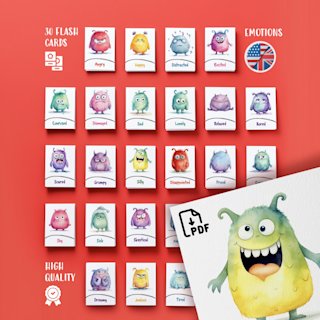
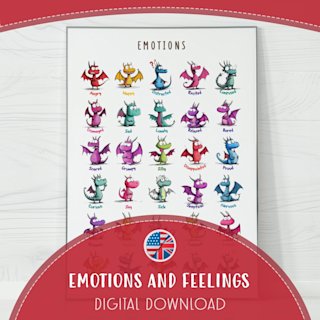
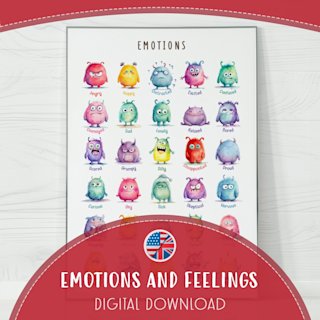
Our Emotions Monster Feelings Flashcards add emotional awareness to yoga: 'When you feel ANGRY, where do you feel it? In your fists? Your jaw? Try LION pose — breathe deep and ROAR the anger out. When you feel SAD, where is it? In your chest? Your shoulders? Try CHILD pose — kneel and fold forward, letting your chest rest on your legs. When you feel SCARED, try TREE pose — ground your roots and stand tall.' Each emotion has a pose. Each pose processes a feeling. The flashcards name the feeling; yoga moves it through the body. 12 monsters, 12 feelings, 12 pathways to peace.
1.Do preschoolers need yoga mats?
Not necessarily. A carpet, rug, or soft floor works fine. Yoga mats are helpful because they define each child's personal space — "This is YOUR mat, stay on YOUR mat" — which prevents bumping into each other. If you use mats, let children decorate them with stickers or washable markers to build ownership. Towels can also work as mat substitutes.
2.How long should a preschool yoga session be?
10-15 minutes for ages 3-4, 15-20 minutes for ages 5-6. Preschoolers cannot sustain attention for adult-length yoga sessions. Instead, do 3-5 poses followed by a game or story, then 2-3 more poses. End with a 2-minute relaxation. Quality over quantity — 5 poses done joyfully is better than 15 poses done reluctantly.
3.Should I use Sanskrit pose names with preschoolers?
No — use animal and nature names instead. "Downward dog" not "Adho Mukha Svanasana." "Cobra" not "Bhujangasana." "Tree" not "Vrksasana." Preschoolers connect to CONCRETE images, not abstract foreign words. The goal is movement, joy, and body awareness — not cultural or linguistic education. If you want to introduce a Sanskrit word, pick ONE and teach it as "the special yoga word for this pose."
4.Can yoga help with preschool behavior?
Yes — research shows that regular yoga practice improves self-regulation, attention span, and classroom behavior. The mechanism is body awareness: children who can FEEL when they're getting wound up can choose to do a calming pose BEFORE a meltdown. Start each day with 5 minutes of yoga and you'll see the difference within 2 weeks. The key is CONSISTENCY — daily 5-minute sessions are more effective than weekly 30-minute sessions.