Articles8 min read

Pattern Activities for Preschoolers: 20+ Games That Teach AB, ABB, and ABC Patterns

Practical pattern activities for preschoolers you can set up in under ten minutes using supplies already in your classroom. Covers individual exploration, small-group collaboration, and whole-class engagement — with adaptations for different ability levels.

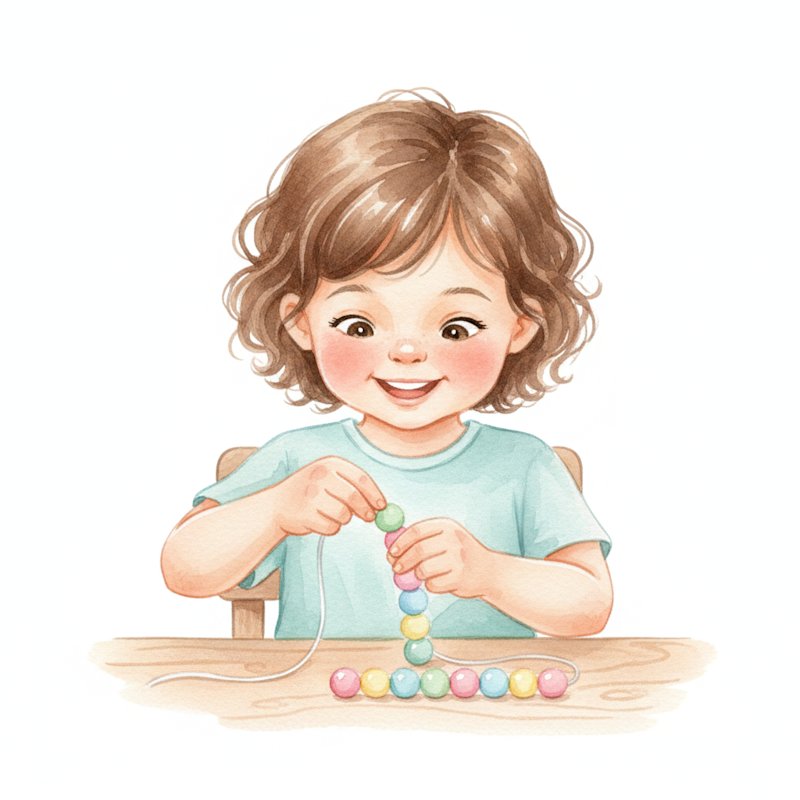
Watercolor illustration of a child threading colorful beads in a repeating pattern

The Red-Blue-Red-Blue Discovery

My daughter lined up her shoes by the front door: red, blue, red, blue, red. She didn't know she'd made a pattern. She just thought it looked "nice." But that simple act — alternating two colors in a repeating sequence — is the beginning of algebraic thinking. Patterns are the first abstract math concept most children encounter, and they're the foundation for everything from skip counting to multiplication to function tables.

According to the National Association for the Education of Young Children, pattern recognition in preschool is one of the strongest predictors of later mathematical achievement. Children who can identify, extend, and create patterns at age 4-5 have significantly stronger math skills in elementary school.
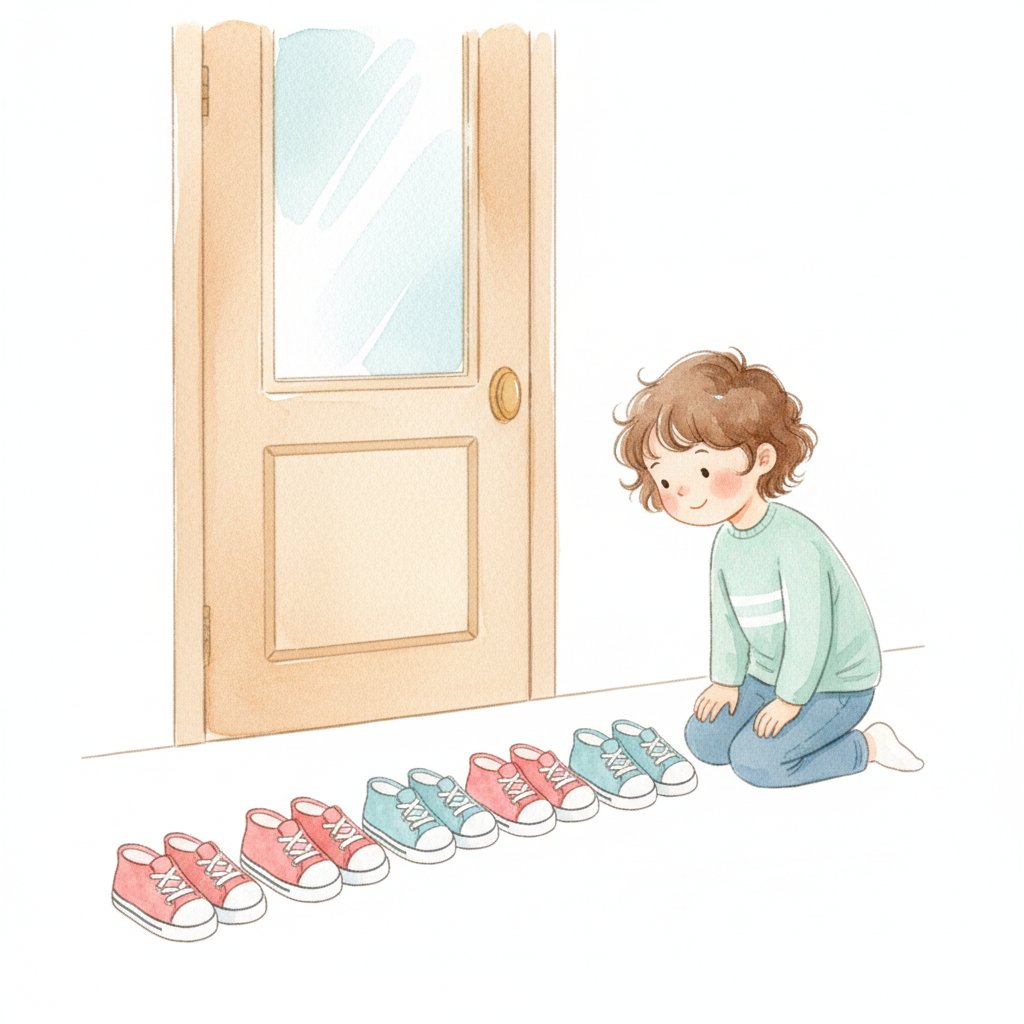
Watercolor illustration of a child arranging shoes by the door in an alternating red and blue pattern

This guide covers 20+ pattern activities for ages 3-6, organized by pattern type and approach. Start with simple AB patterns (red-blue-red-blue) and progress to ABB (red-blue-blue) and ABC (red-blue-green) as children's skills grow. Pair it with our sorting activities for classification skills and our counting activities for number sense.
Types of Patterns to Teach (In Order)

Level 1: AB Patterns (ages 3-4)
The simplest repeating pattern — two elements alternating.
Examples: red-blue-red-blue, clap-stomp-clap-stomp, big-small-big-small

Level 2: AAB and ABB Patterns (ages 4-5)
Three-element patterns with a repeated element.
Examples: red-red-blue, big-big-small, clap-clap-stomp

Level 3: ABC Patterns (ages 4-5)
Three different elements repeating.

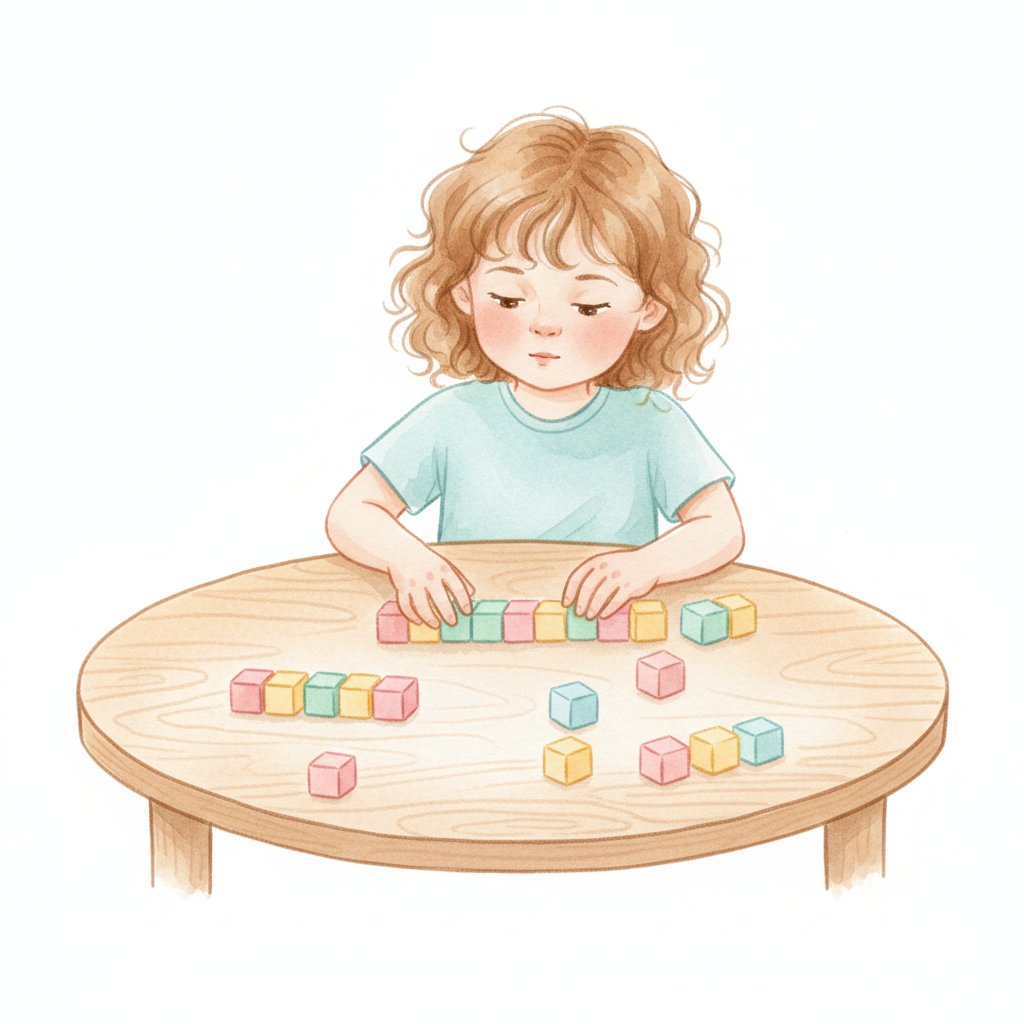
Watercolor illustration of a child arranging colorful counting cubes into repeating pattern rows

Examples: red-blue-green-red-blue-green, dog-cat-fish-dog-cat-fish

Level 4: AABB Patterns (ages 4-5)
Two pairs of elements alternating.
Examples: red-red-blue-blue, big-big-small-small

Level 5: Growing Patterns (ages 5-6)
Patterns that increase by a rule.
Examples: 1 block, 2 blocks, 3 blocks, 4 blocks...

Level 6: Complex Patterns (ages 5-6)
Four or more elements.
Examples: ABCD, ABBC, ABCCD

The progression principle: Don't rush past AB patterns. Children need extensive experience with simple patterns before they can tackle complex ones. A child who can confidently create and extend AB patterns with any material is ready for ABB. A child who struggles with AB needs more practice, not harder patterns.

Pattern TypeExampleWhat Children Do
AB○●○●○●Identify, copy, extend, create
AAB○○●○○●Identify, copy, extend
ABB○●●○●●Identify, copy, extend
AABB○○●●○○Identify, copy, extend
ABC○●△○●△Identify, extend
Growing○○○○●Identify the rule
Color flashcards: the simplest pattern material you already own
Our Colors Flashcards are perfect AB pattern builders. Line them up: red, blue, red, blue — 'What comes next?' Flip to create ABB patterns: red, blue, blue, red, blue, blue. Twelve colors means twelve pattern elements. No prep, no mess, just cards on the table and a child asking 'what comes next?'

AB Pattern Activities (Ages 3-4)

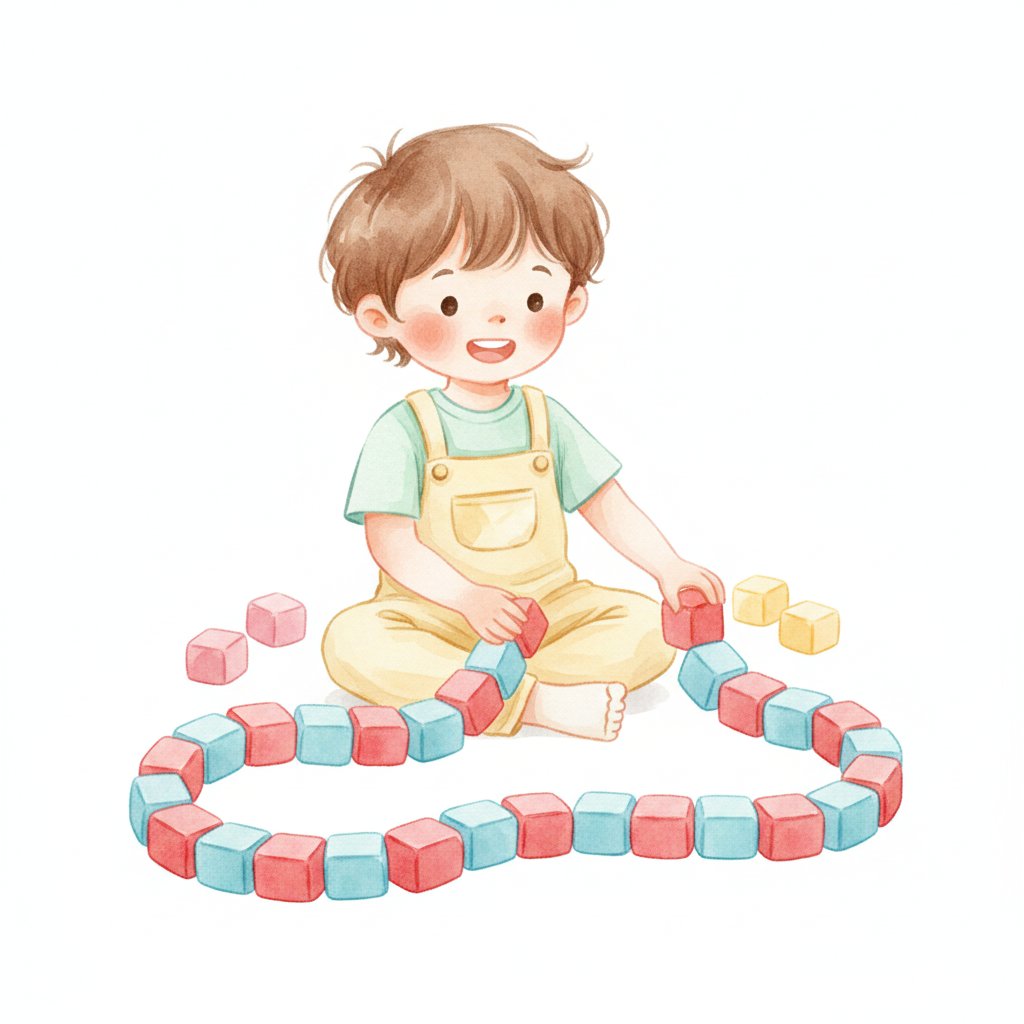
Watercolor illustration of a child building a snap-cube train alternating red and blue

1. Color cube trains
Materials: Two colors of counting cubes or blocks.

What to do: Start a pattern: red, blue, red, blue. "Can you keep my pattern going?" Children add cubes to continue the train. Then swap: "Now YOU start a pattern and I'll continue it."

Why it works: The physical act of connecting cubes is satisfying and the resulting "train" is a visual representation of the pattern. Children can see the entire pattern at once.

2. Movement patterns
What to do: Create body patterns. "Clap, stomp, clap, stomp — what comes next?" Children continue the movement pattern. Try: jump, spin, jump, spin. Sit, stand, sit, stand.

Why it works: Movement patterns engage the whole body and don't require any materials. Children feel the pattern in their muscles. For more movement learning, see our gross motor activities.

3. Sound patterns
Materials: Instruments or body percussion.

What to do: "Drum, shake, drum, shake!" Create rhythm patterns with sounds. Children listen and continue. Try: loud tap, soft tap, loud tap, soft tap.

Extend it: Have children create their own sound patterns for others to continue. "Make a pattern with the drum and the bell. Let's see if we can keep it going!"

4. Snack patterns
Materials: Two types of snack (e.g., crackers and raisins, cereal and blueberries).

What to do: Children create patterns on their plate: cracker, raisin, cracker, raisin. The pattern is the prerequisite for eating. "Show me your pattern first, then you can eat it!"

5. Stamping patterns
Materials: Two different stamps, ink pad, long strip of paper.

What to do: Children stamp an AB pattern along the strip: star, heart, star, heart. The long paper gives room for many repetitions, reinforcing the pattern visually. For more art-based learning, see our art activities.

ABB and ABC Pattern Activities (Ages 4-5)

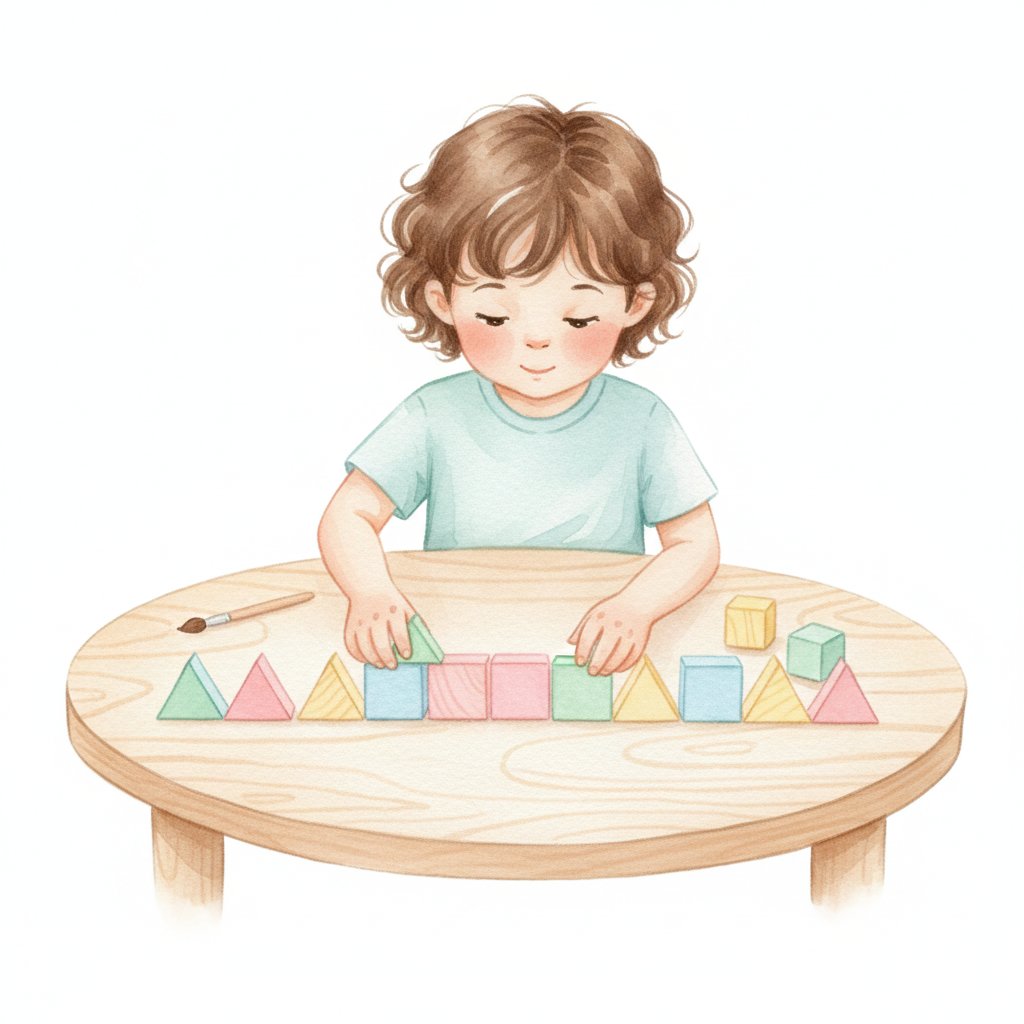
Watercolor illustration of a child arranging geometric pattern blocks into a repeating triangle and square border

6. Bead stringing patterns
Materials: Beads in 3+ colors, string or pipe cleaners.

What to do: Children string beads following a pattern card: ABB=red, blue, blue, red, blue, blue. The fine motor work of stringing beads is paired with cognitive work of maintaining the pattern.

Why it works: Bead stringing requires children to hold the pattern in working memory while their hands execute each step. It's pattern maintenance under motor challenge — excellent cognitive exercise.

7. Pattern block designs
Materials: Pattern blocks (hexagons, trapezoids, triangles, squares, rhombuses).

What to do: Create pattern borders around a shape: triangle, square, triangle, square. Or make pattern rows: hexagon, two triangles, hexagon, two triangles. The geometric shapes add a math dimension. For more shape work, see our shape activities guide.

8. Dot marker patterns
Materials: Dot markers in 3 colors, paper.

What to do: Children stamp ABC patterns: red dot, blue dot, green dot, red dot, blue dot, green dot. Dot markers are easier than writing and children love the satisfying "pop" of each stamp.

9. Building block towers
Materials: Two or three colors of blocks.

What to do: "Build an ABB tower: red, blue, blue, red, blue, blue." Children stack blocks following the pattern. The tower is both a pattern and a balance challenge — if the pattern is wrong, the tower may wobble.

10. Nature pattern bracelets
Materials: Tape (sticky side out, wrapped around wrist), nature items (leaves, petals, pebbles, seeds).

What to do: Children stick items to their bracelet in a pattern: leaf, petal, leaf, petal. The bracelet is wearable art that's also a math lesson. For more nature activities, see our science experiments.

Shape cards make pattern building geometric
Our Shapes Flashcards are pattern starters: circle, square, circle, square — 'What shape comes next?' Lay out ABB patterns: triangle, triangle, square, triangle, triangle, square. Children extend the pattern by finding the next card. Twelve shapes, infinite patterns. Geometry meets algebra meets a card game.

Pattern Games and Challenges (Ages 4-6)

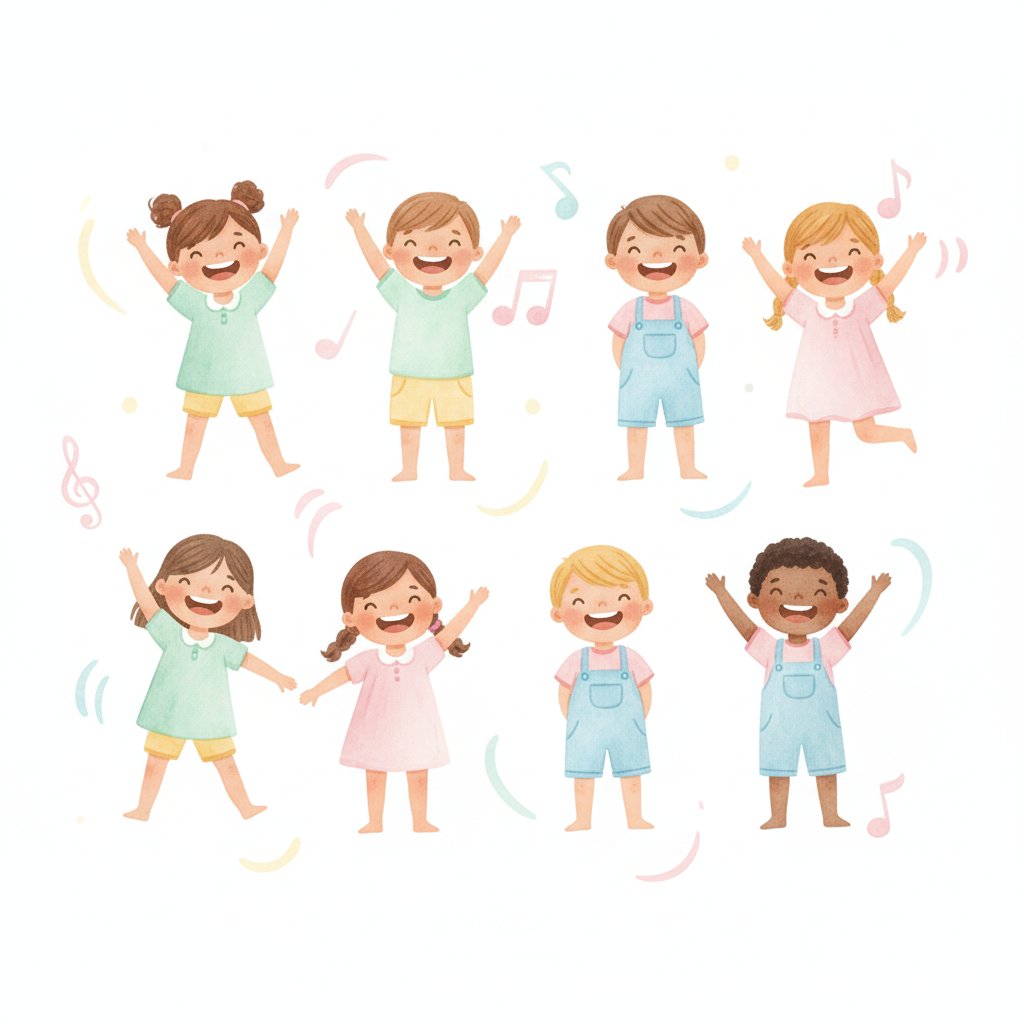
Watercolor illustration of children playing a pattern freeze dance with arms up and arms down

11. Pattern guess what's missing
Materials: Pattern made with objects, one object removed.

What to do: Build a pattern, then cover one item. "Red, blue, red, [COVERED], red, blue — what's under my hand?" Children use the surrounding pattern to deduce the missing element.

Why it works: This requires children to analyze the pattern rather than just continue it — a higher-level thinking skill. They must identify the rule and apply it to a gap.

12. Pattern race
Materials: Two sets of pattern materials, two players.

What to do: Both players get the same pattern card (e.g., ABBA). Race to build the pattern to a designated length. First to finish correctly wins.

13. Pattern scavenger hunt
What to do: "Find patterns around the room!" Children search for real-world patterns: striped shirts (AB), tile floors (ABAB), window grids, bookshelf organization (big, small, big, small). The world is full of patterns — children just need to be told to look.

Extend it: Photograph the patterns children find and create a "pattern museum" display.

14. Pattern freeze dance
What to do: Play music. Children dance. Stop music, call out a pattern: "Show me an AB pattern with your body!" Children pose: arms up, arms down, arms up, arms down. Resume music. Next freeze: "ABB pattern!"

15. Error detection
Materials: A pattern with one deliberate mistake.

What to do: Build a pattern and sneak in an error: red, blue, red, RED, red, blue. "Something is wrong with my pattern. Can you find the mistake?" Children love catching adult errors — it's motivating.

Why it works: Identifying errors requires deep analysis of the pattern structure. Children must understand the rule to spot where it's broken.

Real-World Pattern Activities (Ages 3-6)

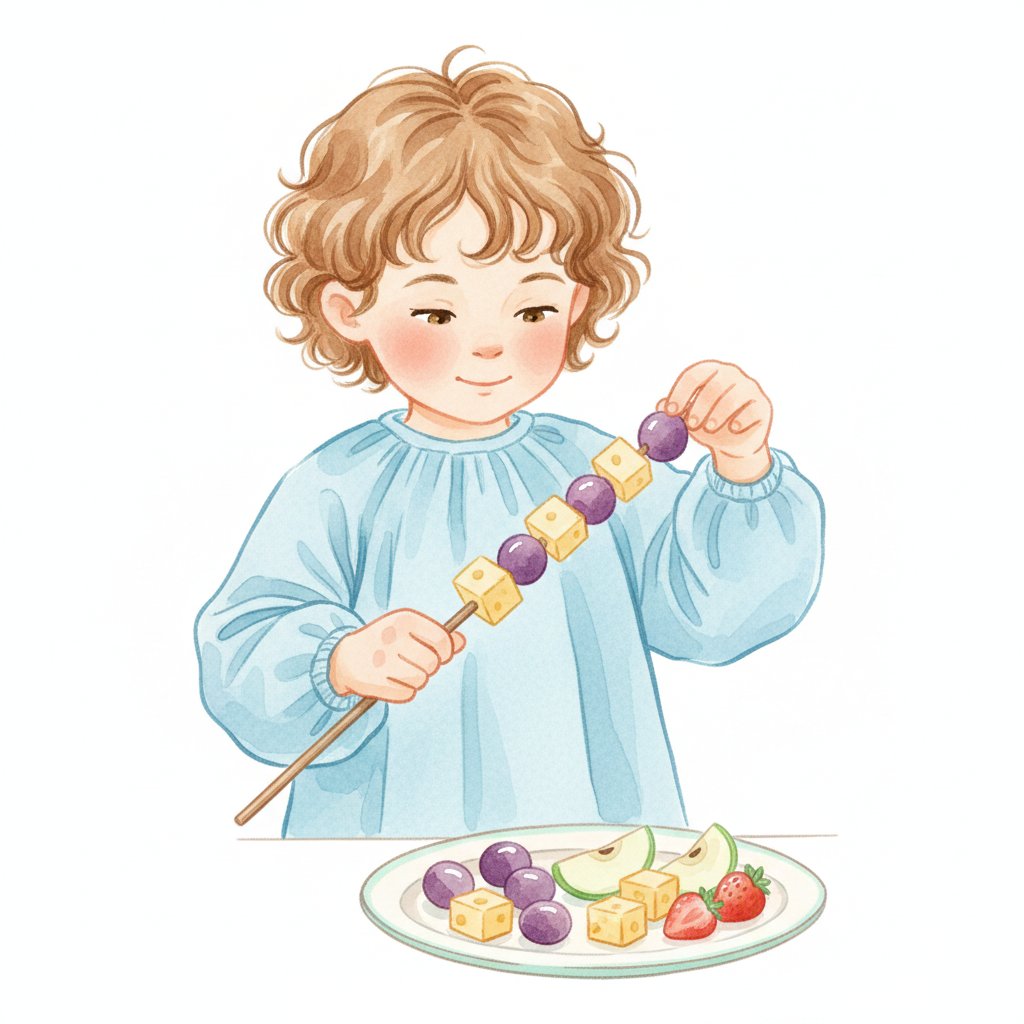
Watercolor illustration of a child threading fruit and cheese onto a skewer in a repeating pattern

16. Calendar patterns
Materials: Classroom calendar.

What to do: Many classroom calendars use alternating colors for dates. Point this out: "Look — red number, blue number, red number. That's a pattern!" Days of the week are a repeating pattern (Monday, Tuesday...Sunday, Monday, Tuesday...). For more calendar learning, see our days of the week guide.

17. Clothing patterns day
What to do: Have a "pattern day" where children wear patterned clothing. Stripes, polka dots, plaids, zigzags. Photograph and sort: "Which patterns are AB? Which are ABB?" Clothing is pattern curriculum children wear on their bodies.

18. Musical pattern songs
Materials: Songs with repeating patterns.

What to do: Many children's songs are built on patterns. "Bingo" has a letter-removal pattern. "There Was an Old Lady" has a growing pattern. Point out the pattern: "Did you notice the song repeats the same part? That's a pattern!"

19. Pattern snack creations
Materials: Multiple snack types (fruit, crackers, cheese).

What to do: Children create edible pattern kabobs: grape, cheese, grape, cheese on a skewer. Or pattern plates: apple slice, banana slice, apple slice, banana slice. The reward for correct patterning is eating.

20. Weather pattern tracking
Materials: Weather chart.

What to do: Track weather daily on a chart. After two weeks, look for patterns: "Was it sunny three days in a row? Did rain come after cloudy days?" Real data, real pattern analysis. For more weather learning, see our weather activities guide.

Educational posters: pattern reference on the wall
Our Educational Poster Set includes alphabet, numbers, shapes, colors, days, and more — each one a visual pattern children see daily. The alphabet is an A-Z pattern. Numbers are a 1-10 sequence pattern. Days of the week are a Monday-Sunday repeating pattern. When patterns live on the wall, children internalize them without a lesson. Walls teach.
1.At what age do children start understanding patterns?
Children begin recognizing simple patterns around age 3. Most 3-year-olds can identify and copy an AB pattern when it's demonstrated. By age 4, most children can extend an AB pattern independently and begin working with ABB and ABC patterns. By age 5-6, children can create their own patterns and identify the "rule" behind a pattern. Start simple and add complexity as the child demonstrates mastery.
2.Why is pattern recognition important for math?
Patterns are the foundation of algebraic thinking. When children recognize that "red, blue, red, blue" follows a rule, they're doing pre-algebra. Patterns also underpin skip counting (2, 4, 6, 8 is a pattern), multiplication (repeated groups), and function tables (input-output patterns). Children who are strong at pattern recognition find elementary math significantly easier.
3.My child can copy patterns but can't create their own. Is this normal?
Yes, this is the normal progression: identify → copy → extend → create. Creating original patterns is the hardest step because it requires generating the rule, not just following one. Continue with copy and extend activities until the child can do them confidently. Then encourage creation by offering two materials and saying "make your own pattern" without specifying the type.
4.How do I connect patterns to other math skills?
Patterns connect naturally to counting (counting is a number pattern), skip counting (2, 4, 6 is an AB pattern with numbers), and shape recognition (geometric patterns). Whenever your child works with patterns, name the math: "Your pattern goes red, blue, red, blue — that's an AB pattern. Numbers can make patterns too: 1, 2, 1, 2!" Making the connection explicit bridges pattern work to number work.