Articles9 min read

The Muffins That Taught Fractions

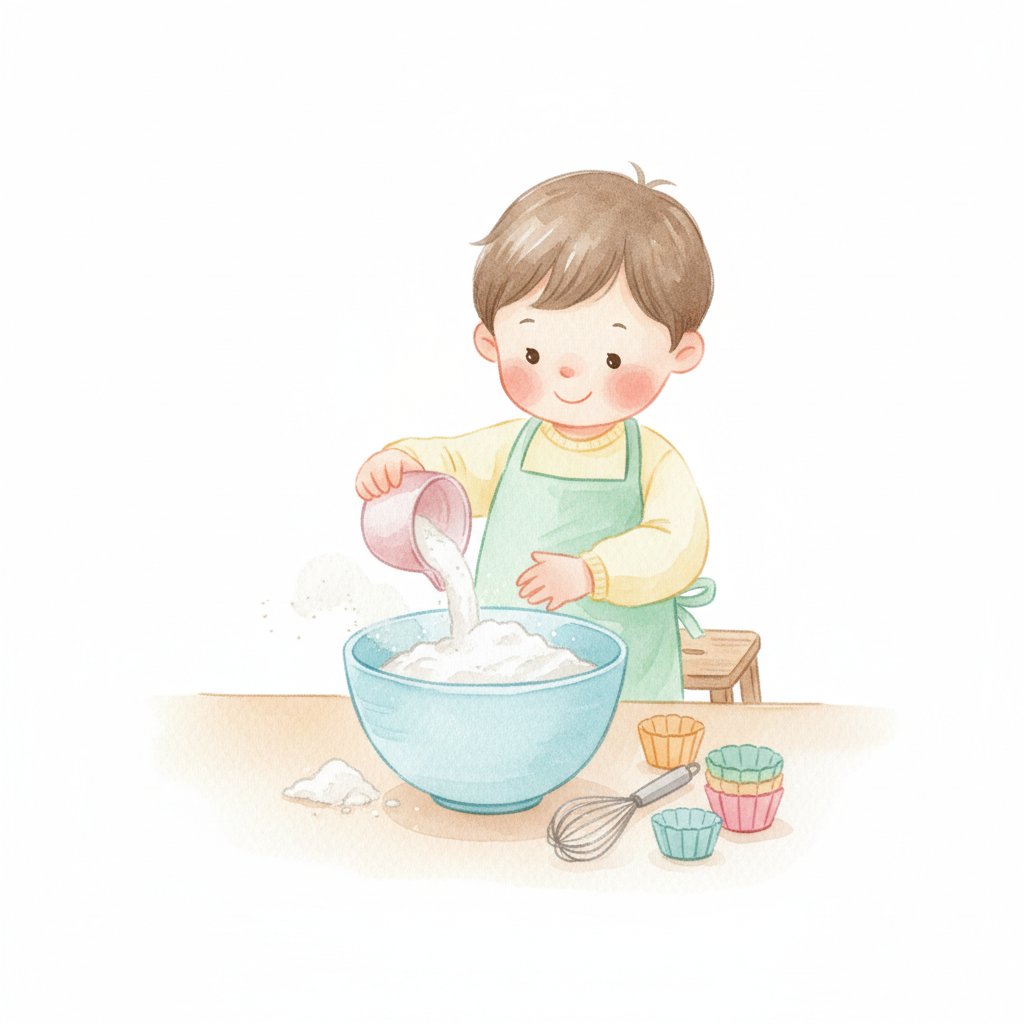
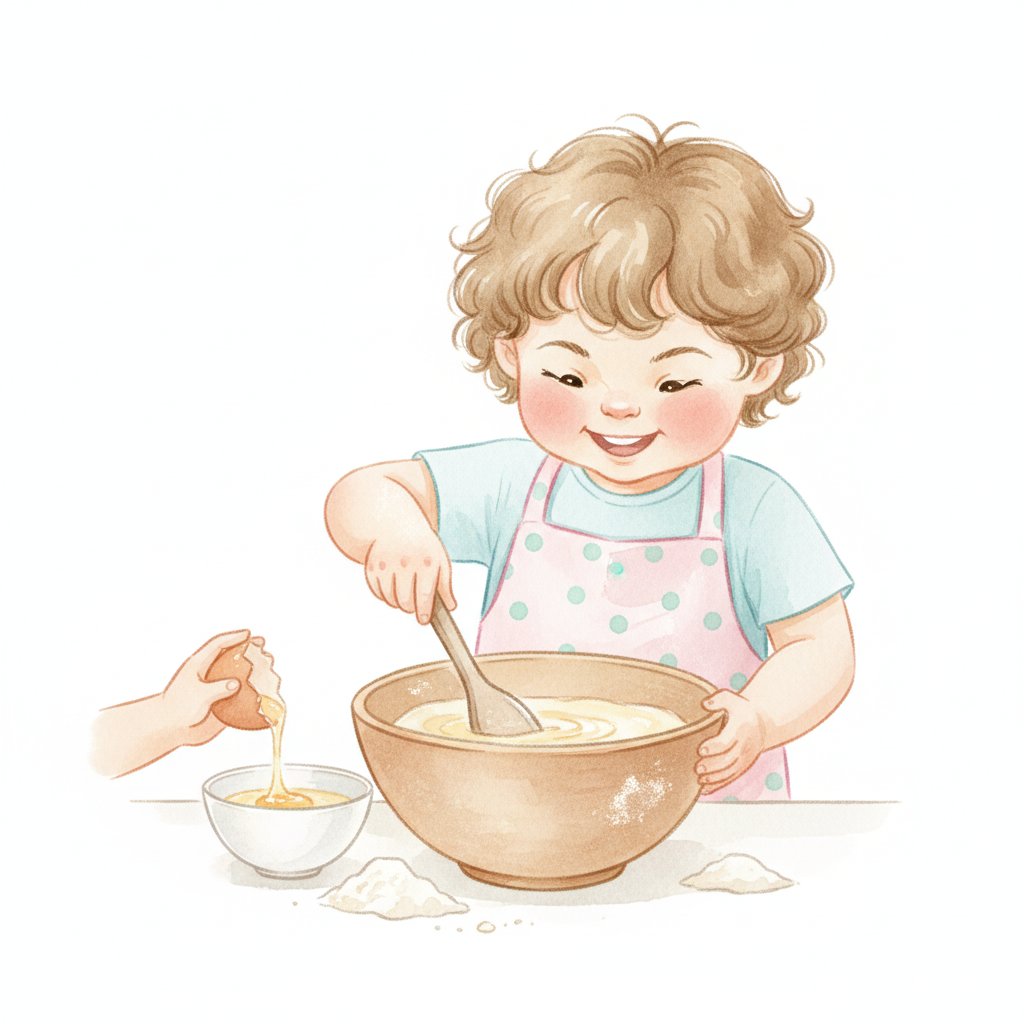
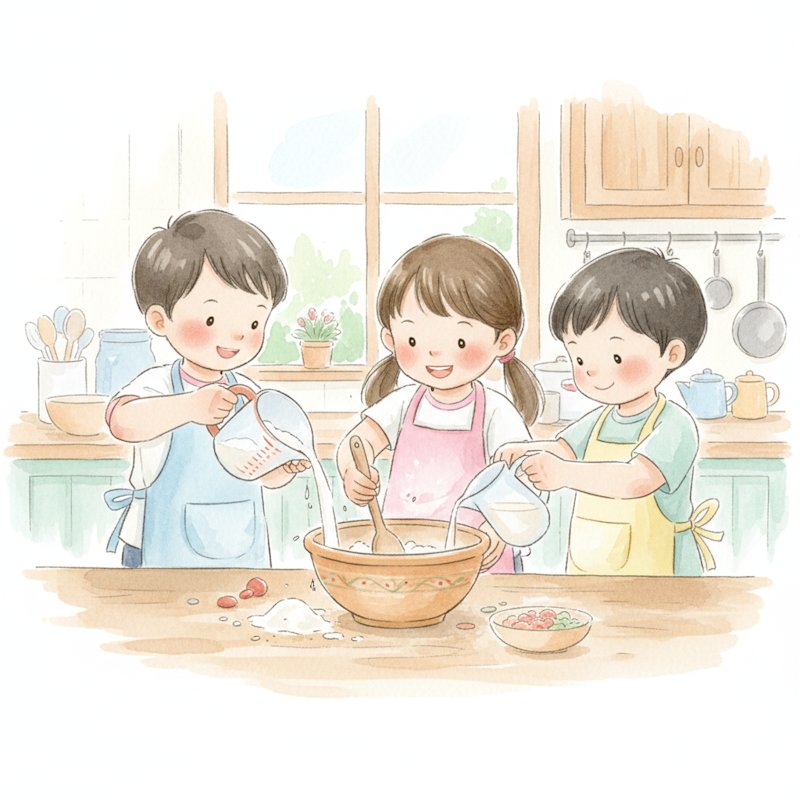
My four-year-old stood on a step stool at the kitchen counter, holding a measuring cup. "We need one cup of flour," I said. She scooped, leveled with her finger, and dumped. "Now half a cup of sugar." She looked at the measuring cup, then at me. "Which one is half?" I showed her. She filled it, dumped it, and said: "So TWO of these would make one whole cup?" Yes. That's fractions. At age four. While making muffins.

Cooking is the single most math-rich, science-rich, literacy-rich activity you can do with a preschooler — and children are naturally motivated because the end result is something they can eat. According to research from Teachers College, Columbia University, children who participated in weekly cooking activities showed significantly greater gains in math vocabulary, measurement understanding, and sequencing skills compared to children who received the same instruction through worksheets.

This guide covers 20+ cooking activities for ages 3-6, organized by skill: measuring and math, food science, no-bake recipes, and food-based art. Pair it with our counting activities for number practice and our science experiments for more kitchen science.

Why the Kitchen Is the Best Classroom

Math you can taste: Cooking requires counting (3 eggs), comparing (is the cup full?), sequencing (first mix dry, then add wet), and fractions (half, quarter). These aren't abstract concepts on a worksheet — they're real operations with visible, tangible results.

Science you can eat: Baking is chemistry. Mixing ingredients changes them. Heat transforms batter into cake. Yeast makes dough rise. These transformations are science experiments children can observe, hypothesize about, and taste.

Skills developed through cooking:

SkillCooking ActivityReal-World Transfer
Counting"Add 3 eggs"One-to-one correspondence
Measuring"One cup of flour"Volume and quantity
Fractions"Half a cup"Part-whole relationships
Sequencing"First, then, next"Following directions
Fine motorStirring, pouring, kneadingPencil grip and handwriting
VocabularyRecipe words (mix, blend, fold)Language development
IndependenceMaking food themselvesSelf-efficacy and confidence

Safety first: All recipes in this guide are no-heat or adult-heat (adult operates the oven/stove, child assembles). Children use safe tools (butter knives, tear-by-hand, spoons). Always supervise children in the kitchen.

Age guide: 3-year-olds can stir, pour, tear, and wash produce. 4-year-olds can measure, crack eggs, spread, and cut soft items with a butter knife. 5-6 year olds can follow simple recipes with pictures and do most steps independently.

Farm animal flashcards meet farm-to-table cooking
Our Farm Animals Flashcards introduce the animals that produce our food: cow → milk, chicken → eggs, sheep → wool (not food, but still fascinating!). Before cooking, show the card: 'We're using eggs today — which animal gives us eggs?' Food vocabulary meets animal science in one card flip.

Measuring and Math Activities (Ages 3-6)

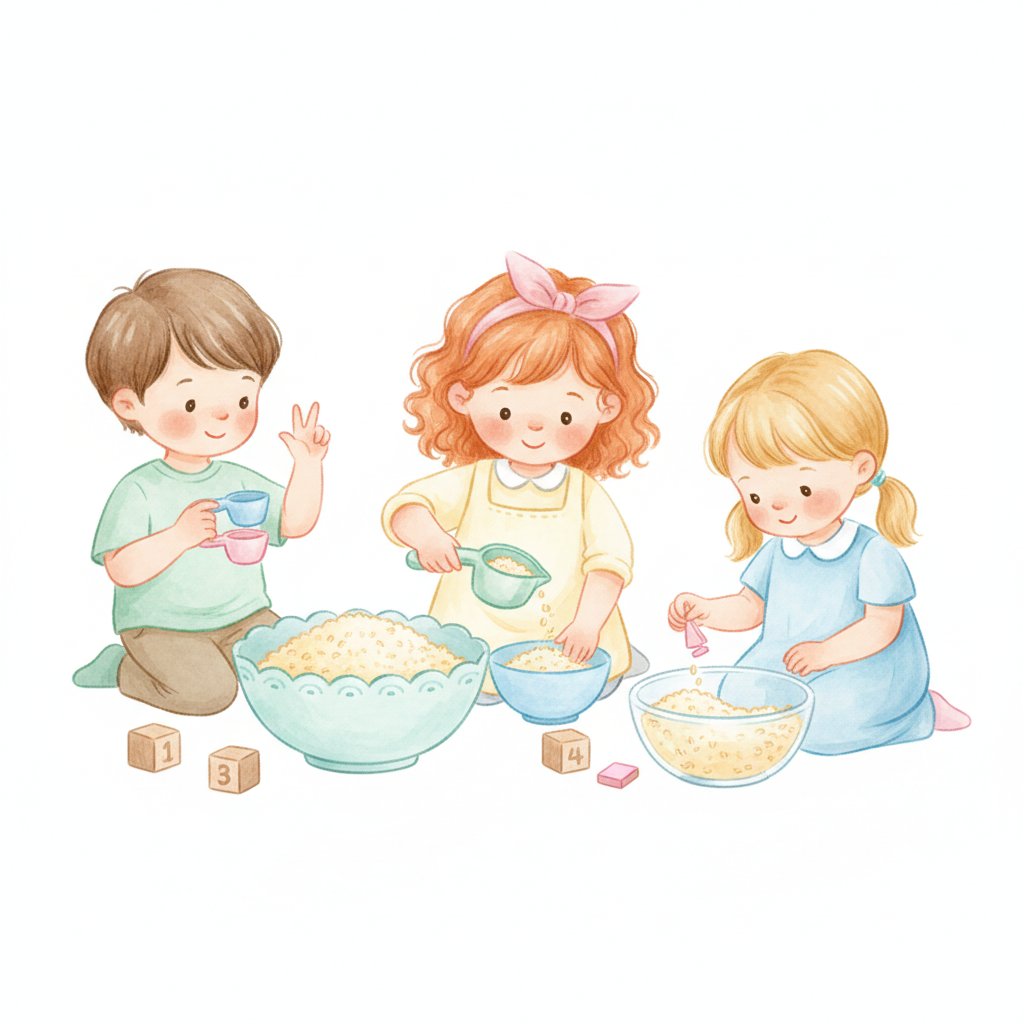
1. Scoop and compare
Materials: Dry rice or beans, measuring cups (1 cup, 1/2 cup, 1/4 cup), 3 bowls.

What to do: "How many 1/4 cups fill the 1 cup?" Children scoop and count. The answer (4) is a fraction lesson they'll remember because they discovered it themselves.

Extend it: "How many 1/2 cups fill the 1 cup?" Then: "If 2 halves make 1 whole, and 4 quarters make 1 whole, how many quarters make a half?" Let them test it physically.

2. Kitchen scale weighing
Materials: Kitchen scale, assorted fruits/vegetables.

What to do: Children predict which is heavier (apple or orange?), then weigh to check. Record weights. "The apple is 150 grams and the orange is 200 grams. Which is heavier? By how much?"

Why it works: Real measurement with real numbers builds number sense. Children who use scales in preschool understand weight as a measurable property, not just "heavy" or "light." For more math activities, see our math readiness guide.

3. Recipe picture sequencing
Materials: Recipe with picture steps (draw or photograph each step).

What to do: Cut picture steps apart. Children arrange them in order: first, next, then, last. This teaches sequencing — a skill used in reading comprehension, writing, and following multi-step directions.

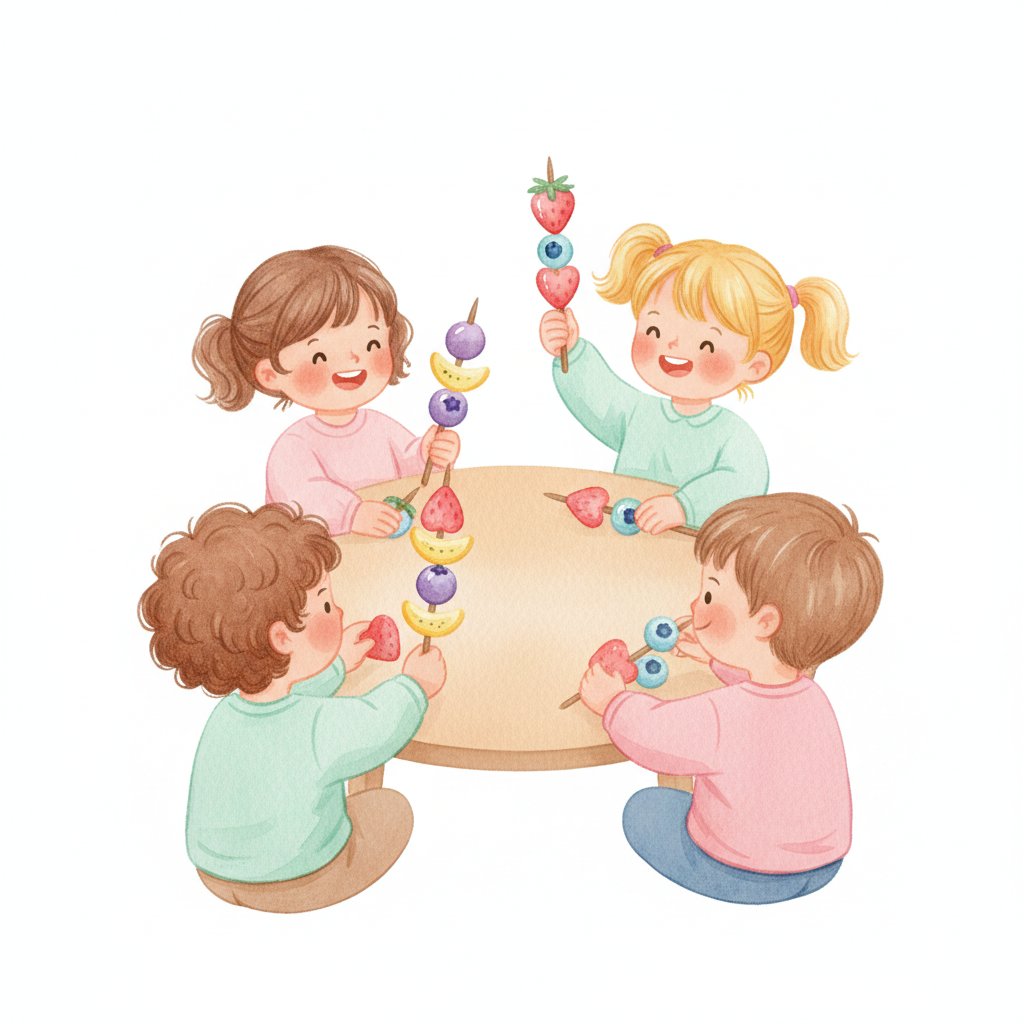
4. Pattern fruit skewers
Materials: Cut fruit pieces (strawberries, banana slices, blueberries, grapes).

What to do: Children create patterns on skewers: strawberry-banana-strawberry-banana. Increase complexity: strawberry-banana-blueberry-strawberry-banana-blueberry. Then eat the pattern.

Why it works: Patterning is algebraic thinking. Making patterns with food is the most motivating patterning activity possible — because you eat the result.

5. Pizza fraction fun
Materials: English muffins, sauce, cheese, toppings.

What to do: Cut an English muffin in half. "This is ONE muffin cut into TWO halves. Each half is one-half." Top each half differently. "One-half has pepperoni, one-half has mushrooms." For older children: cut into quarters.

Kitchen Science Activities (Ages 3-6)

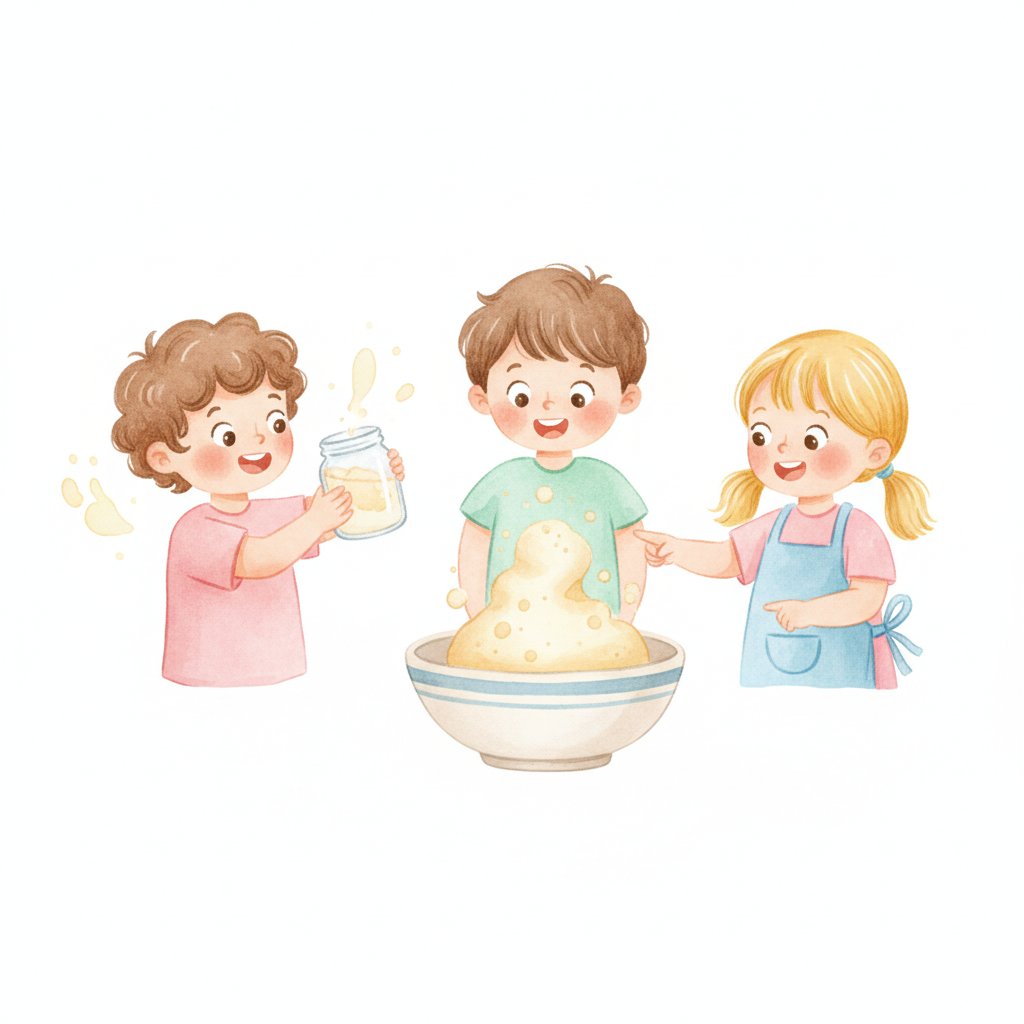
6. Bread dough rising
Materials: Flour, yeast, warm water, sugar, bowl, plastic wrap.

What to do: Mix yeast, warm water, and sugar. Wait 5 minutes — watch it bubble. Add flour and knead. Cover with plastic wrap and set in a warm spot. Check every 30 minutes. "Why is it getting bigger?"

The science: Yeast is a living microorganism that eats sugar and produces carbon dioxide gas. The gas gets trapped in the dough, making it expand. This is biology (living organisms), chemistry (fermentation), and physics (gas expansion) in one bowl.

7. Butter in a jar
Materials: Heavy cream, jar with tight lid, marble (optional).

What to do: Pour cream into jar (add marble). Shake vigorously for 5-10 minutes. First it becomes whipped cream. Keep shaking — it separates into butter and buttermilk.

The science: Agitation breaks the fat molecules in cream, causing them to clump together into butter. The liquid that remains is buttermilk. A liquid turns into a solid through physical force.

8. Color-changing cabbage water
Materials: Red cabbage, hot water (adult), clear cups, vinegar, baking soda.

What to do: Steep red cabbage in hot water (adult). The purple water is a pH indicator. Add vinegar to one cup (turns pink — acid). Add baking soda to another (turns blue-green — base). Add other liquids to test.

The science: Red cabbage contains anthocyanin, a pigment that changes color based on acidity. This is real acid-base chemistry that children can see and understand.

9. Melting test
Materials: Butter, chocolate chips, ice cube, cheese slice.

What to do: Place each item on a plate. Predict: "Which will melt first at room temperature?" Check every 10 minutes. Then test with gentle heat (adult holds near warmth).

The science: Different materials have different melting points because their molecular structures are different. This introduces the concept that matter changes state under different conditions.

10. Five senses taste test
Materials: Small samples of foods with different tastes: lemon (sour), sugar (sweet), salt (salty), dark chocolate or grapefruit (bitter), plain crackers (neutral).

What to do: Children taste each sample with eyes closed. Name the taste. Sort into categories: sweet, sour, salty, bitter.

The science: Taste buds on the tongue detect different flavor categories. Children learn that "taste" is a scientific property, not just a preference. This connects to our body parts activities for learning about senses.

Cooking day: kids love predictable kitchen routines
Our Days of the Week Poster makes 'Cooking Wednesday' visible and exciting. Children see the schedule and prepare: 'Today is cooking day!' Predictable routines build anticipation, and anticipation builds engagement. Hang it in the kitchen area — cooking isn't an event, it's a weekly habit.

No-Bake Recipes Children Can Make (Ages 3-6)

11. Trail mix math
Materials: Bowls of: pretzels, raisins, chocolate chips, cereal, dried cranberries.

What to do: "Take 5 pretzels, 3 raisins, 2 chocolate chips, and 4 cereal pieces." Children count each item, mix, and eat. This is counting with one-to-one correspondence, and the reward is built in.

Extend it: "Make a recipe card for your trail mix. Draw the ingredients and write the numbers." Now it's counting + writing + drawing.

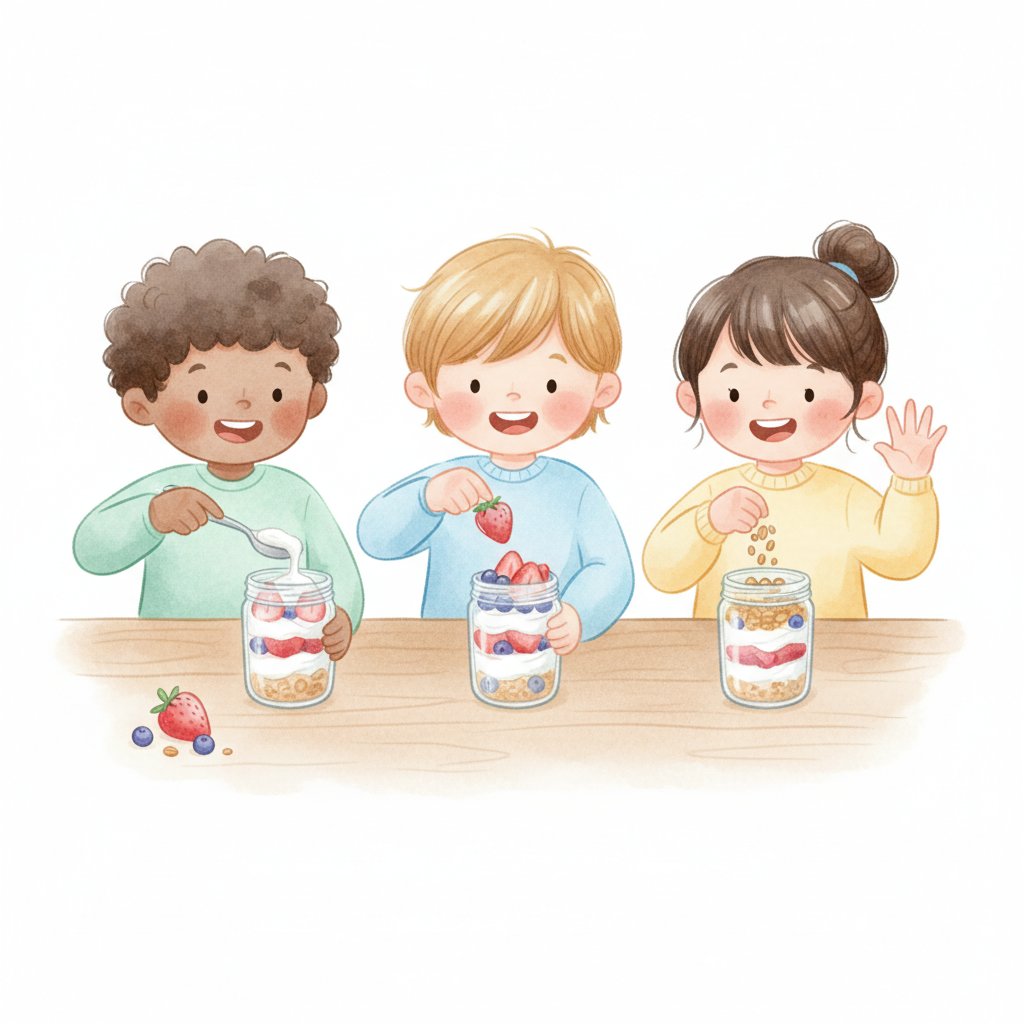
12. Fruit and yogurt parfaits
Materials: Yogurt, cut fruit, granola, clear cups.

What to do: Children layer ingredients: yogurt, fruit, granola, yogurt, fruit, granola. Counting layers, creating patterns, and the clear cup shows the beautiful result.

Why it works: Layering teaches sequencing (what goes first, second, third) and patience (you can't eat until it's built). The visual reward in the clear cup reinforces the process.

13. Ants on a log
Materials: Celery sticks, cream cheese or peanut butter, raisins.

What to do: Children spread filling on celery (fine motor practice), then place raisins on top ("ants"). Count the ants. "How many ants can fit on your log?"

Why it works: Spreading with a knife builds the same hand control used for writing. Plus it's a classic that children love.

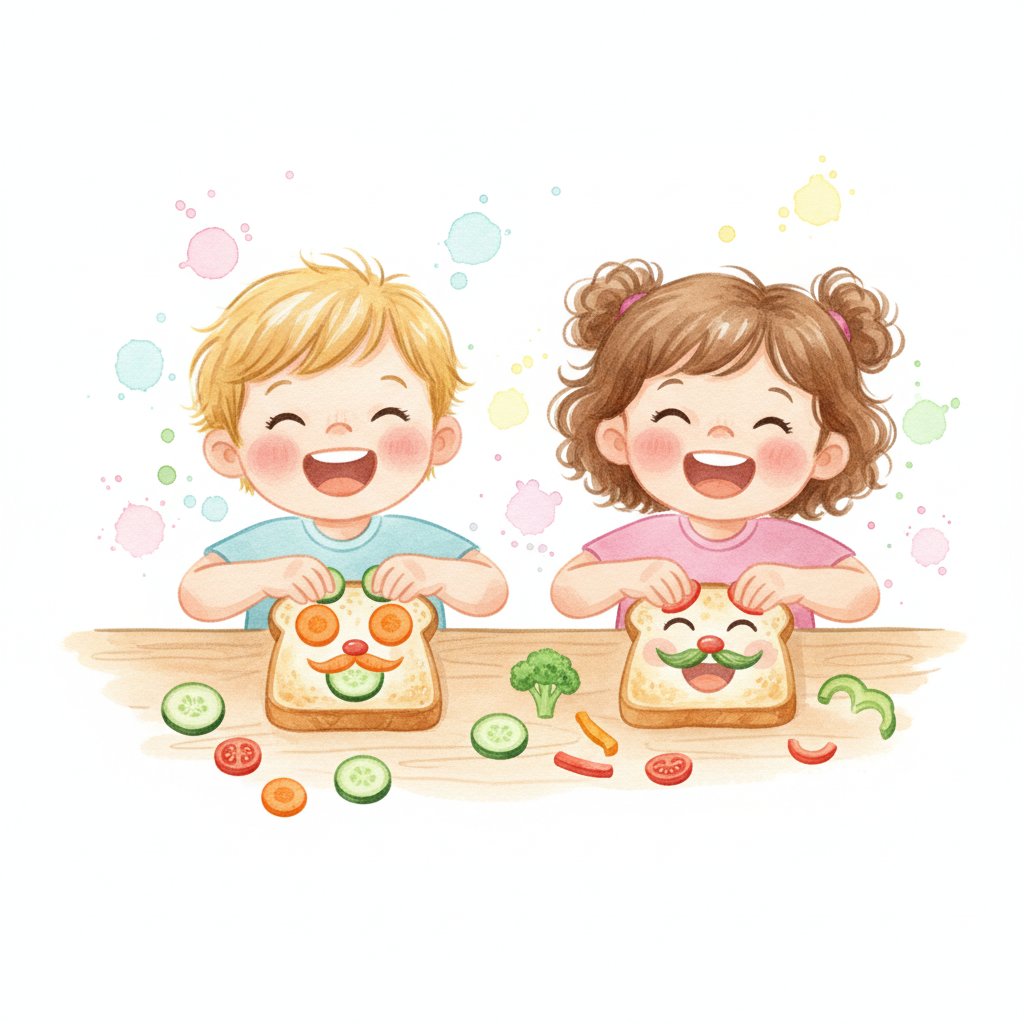
14. Sandwich faces
Materials: Bread, cream cheese or hummus, vegetable pieces (carrots, cucumbers, cherry tomatoes, bell peppers).

What to do: Children spread the base, then create faces with vegetable pieces. "Make a happy face. Make a surprised face." Then eat the face.

Why it works: This is food art — creativity with healthy ingredients. Children who make food art are more likely to eat vegetables because they have ownership over the creation.

15. English muffin pizzas
Materials: English muffins, pizza sauce, shredded cheese, toppings.

What to do: Children assemble: sauce, cheese, toppings. Adult bakes at 375°F for 10 minutes. Children watch through the oven door as cheese melts and bubbles.

The science: Heat causes the cheese proteins to unwind and the fat to melt, creating that stretchy texture. Children observe a phase change (solid → semi-liquid → solid again as it cools).

Food Art Activities (Ages 3-6)
16. Color sorting snack
Materials: Fruits and vegetables in multiple colors: red (strawberries, tomatoes), orange (carrots, oranges), yellow (banana, corn), green (grapes, cucumbers), blue/purple (blueberries, grapes).

What to do: Children sort foods by color on a plate. "Find all the red foods. Find all the green foods." This is categorization — a fundamental math and science skill.

Why it works: Sorting food by color teaches classification, color recognition, and nutrition simultaneously. Children who categorize foods are developing the same thinking used to categorize letters, numbers, and shapes. See our sorting activities for more categorization practice.

17. Veggie stamp art
Materials: Cut vegetables (celery hearts make roses, okra makes flowers, potatoes can be carved into shapes), washable paint, paper.

What to do: Dip cut vegetables in paint and stamp on paper. Each vegetable creates a different shape. Children experiment: "What shape does broccoli make? What about a carrot cross-section?"

Why it works: Art with food connects the kitchen to the art table. Children observe natural patterns in vegetable cross-sections — broccoli looks like tiny trees, celery looks like crescent moons. For more art ideas, see our art activities guide.

18. Build-a-house Graham cracker construction
Materials: Graham crackers, cream cheese or frosting (as "mortar"), assorted decorations.

What to do: Children use frosting to stick graham crackers together, building houses or structures. Engineering with edible materials.

Why it works: This is block play you can eat. Children learn about structural stability (walls need support), spatial reasoning (how pieces fit together), and fine motor control (applying frosting precisely). When it falls, they rebuild — persistence in action.

19. Banana sushi
Materials: Tortillas, bananas, peanut butter or cream cheese, plastic knife.

What to do: Children spread filling on a tortilla, place a banana at the edge, roll tightly, then slice into "sushi rolls" with a plastic knife.

Why it works: Rolling develops bilateral coordination (two hands working together). Slicing with a knife is fine motor practice. The result looks impressive but requires zero cooking.

20. Edible color wheel
Materials: Foods in primary colors — red (strawberries), yellow (banana), blue (blueberries). Plus mixing space.

What to do: Arrange primary colors. Mash and mix: red + yellow=orange (strawberry + banana). Red + blue=purple (strawberry + blueberry). Yellow + blue=green (banana + blueberry, approximately).

Why it works: Color mixing with food is multisensory — children see, smell, taste, and feel the color change. It reinforces the same color theory as paint mixing. For more color exploration, see our color activities.

Cooking emotions: how does food make you feel?
Our Emotions Monster Feelings Flashcards pair perfectly with cooking: before cooking, children pick the card that shows how they feel. After cooking (and eating), pick again. 'Did making muffins change how you feel?' Cooking is therapeutic — and these cards make emotional awareness part of the recipe.
1.What age can children start cooking?
Children as young as 2 can participate in simple kitchen tasks: washing vegetables, tearing lettuce, stirring batter. By age 3, children can pour, scoop, and spread. By age 4, they can measure, crack eggs, and cut soft items with a butter knife. By age 5-6, they can follow simple picture recipes nearly independently. Start with one task and add complexity as skills develop.
2.How do I manage the mess?
Accept that cooking with preschoolers is messy — that's part of the sensory experience. Minimize mess with strategies: work on a rimmed baking sheet (catches spills), use a splat mat under the work area, give each child their own bowl and tools, and build cleanup into the activity ("cooks clean their station"). Children who learn to clean up after cooking are learning responsibility alongside culinary skills.
3.What about food allergies in a classroom?
Always check with families about allergies before any food activity. Common allergens to avoid in classroom settings: nuts, tree nuts, and dairy (some children). Safe alternatives: sunflower butter instead of peanut butter, dairy-free yogurt, and fruit-based activities (no common allergens). Post allergy information visibly in the cooking area.
4.Can cooking activities work with large groups?
Yes, with small-group rotation. Set up a cooking station for 3-4 children at a time while other children do different activities. Rotate every 15-20 minutes. Each small group makes an individual portion. This keeps engagement high and mess manageable.